Region by Region: How a Bank Patented the Audit Trail for Human-vs-AI Writing
For most of computing history, one assumption did all the work: if a person is sitting at a keyboard, what comes out is theirs. The file's author metadata was whoever was logged in. That assumption has been quietly collapsing since 2022. Today a single document can be partly typed by a human, partly generated by a large language model invoked from inside the same editor, and partly pasted in from somewhere else, with no native record of which part is which. A patent granted in November 2025, assigned to one of the largest banks in the United States, is a serious attempt to make that record automatic, region by region, in real time.
US 12462318B2, titled "Content editing software via automatic and auditable authorship attribution," landed at the USPTO on November 4, 2025, after a priority chain that begins with a January 2024 provisional. It is part of an active family with four more US applications still pending, and it has already picked up five forward citations in its first few months. The patent is unusually broad in what it claims to cover, ranging from word processors and IDEs to image editors, video editors, presentation tools, and the compose box inside an email client or social app. It is also unusually concrete in what it asks the software to do. Read closely, it is less an AI-detector and more a provenance ledger (in plain terms, an unforgeable log of where each piece of content came from) built into the editor itself, one that labels each region of a file the moment it is produced.
What makes it worth a briefing is the combination. The assignee is a bank, the technology is editor-level, and the use case the claims actually specialize on is a video platform ruling on third-party "unauthorized digital replica" complaints, the patent's own legal-style way of saying what the press calls a deepfake or a likeness violation, where someone's face, voice, or persona has been reproduced without consent. That framing is a tighter match to today's deepfake and likeness disputes than almost anything else in the recent IP literature.
The patent at a glance
- Patent number: US12462318B2
- Title: Content editing software via automatic and auditable authorship attribution
- Assignee: U.S. Bank N.A.
- Inventors: Christopher Ziolkowski, Valerie Lancelle, Christopher Davis
- US application number: 19/241881
- Filed: June 18, 2025
- Granted: November 4, 2025
- Earliest priority: U.S. provisional 63/625,601, January 26, 2024
- Anticipated expiration: January 23, 2045
- Claims: 20 total (3 independent)
- Drawings: 59 figures
- Family status: Active; four US continuations still pending (19/346,008, 19/361,282, 19/379,892) plus the parent PCT/US2025/012747
- Source / venue: USPTO; Google Patents record at https://patents.google.com/patent/US12462318B2/en
When the cursor stopped telling the truth
The patent opens with a quietly devastating observation. For decades, the file's author was whichever user account saved the document. That was a useful, if coarse, proxy for the human who wrote this. Two things broke the proxy at the same time. The first was the integration of generative AI directly into content editors: GitHub Copilot and Office Copilot sit inside the same buffer where you are typing, and they insert text in the same places you would. The second was multimodal assistance. A model like GPT-4o can hand you a paragraph, an image, and a chart in a single turn, and your editor receives all of it as ordinary input. After that turn, there is no reliable way to look at the file and tell which characters came from your fingers and which came from the model.
This is not a small problem. The background section of the patent cites work by Alemohammad and Shumailov showing that training generative models on their own outputs causes "model collapse," a steady erosion of quality as the corpus gets more synthetic. It also cites the U.S. Copyright Office's March 2023 guidance asking registrants to disclose AI involvement in any work they want to register. Both of those concerns require a piece of information that, today, no editor actually captures: which regions of a finished file are human, which are artificial, and which are imported from somewhere with unknown provenance.
Traditional "redline" markup does not solve this. Word's track changes attributes edits to a user account, not to the kind of input that produced them. Git attributes a commit to an account, not to the underlying creation process. Either of those labels can be changed by a sufficiently motivated user. Worse, neither system works on plain-text source code, where the most consequential AI assistance now lives, because the file format lacks the rich-text scaffolding those tools need.
Region-level receipts for the writing process
At the heart of the patent is a simple inversion. Stop trying to detect who wrote a finished document, and instead attach a small marker to each region of the document as it is being produced. That marker is called an authorship token, which is really just a signed metadata record saying who or what produced the bytes in that region. The token says one of four things: a human wrote this, an AI wrote this, a mix of the two wrote this, or this came in from outside and we do not know who wrote it. Once those markers are attached, every later question has a structured answer waiting for it: who owns this paragraph, can it be used as training data, was it a deepfake, is it a copyright violation.
Storage is flexible. A token can take several forms: a plain-text comment in a source file (something like // <auth: human, jdoe@bank.com, 2025-11-04>), an entry in a sidecar file, a row in a relational database, or a record in a tamper-resistant store like a blockchain or a Merkle tree, which is a hierarchical hash structure where any change to a single byte at the bottom propagates up and invalidates the value at the top. That last property is what makes it cheap to prove nothing was quietly rewritten. The patent explicitly contemplates that the content being labeled and the label itself can live in different places, and that the label can be encrypted or signed so an author cannot quietly rewrite it. The system also keeps a private log of human input so that, even if the on-disk labels are challenged, there is a secondary record (think of it as the editor's own audit trail).
Detection is layered. The first signal is the most boring and the most reliable: did the keystroke come from a human interface device or from a software process? If the first, the region is human-authored. If the second, it is AI-authored. Beyond that, the patent layers on keystroke cadence, paste detection, AI-tool invocations, an edit-significance threshold, the presence of entropic errors (the messy, low-information mistakes a human naturally makes while typing, the kind a well-trained language model has been specifically optimized to avoid: typos, half-deleted words, abandoned restarts), and embedding-based similarity to known human or AI corpora. The system can also be told to give the AI a deliberate signature, for example a clumsy _AI_GENERATED suffix on every variable it names, so its output is re-identifiable later.
Two of the patent's more interesting tricks are worth calling out. The first is the "AI date," a cutoff timestamp before which content is retroactively assumed to be human-authored, so legacy codebases can be labelled in bulk. The second is active probing: the editor can be configured to constrain the AI to produce output with detectable statistical features (unusual syllable counts, awkward identifiers) so that, even after the fact, the labels can be reconstructed from the text itself.
Inside the authorship engine
The picture below is the simplest possible version of the mechanism, drawn directly from the patent's broader disclosure.
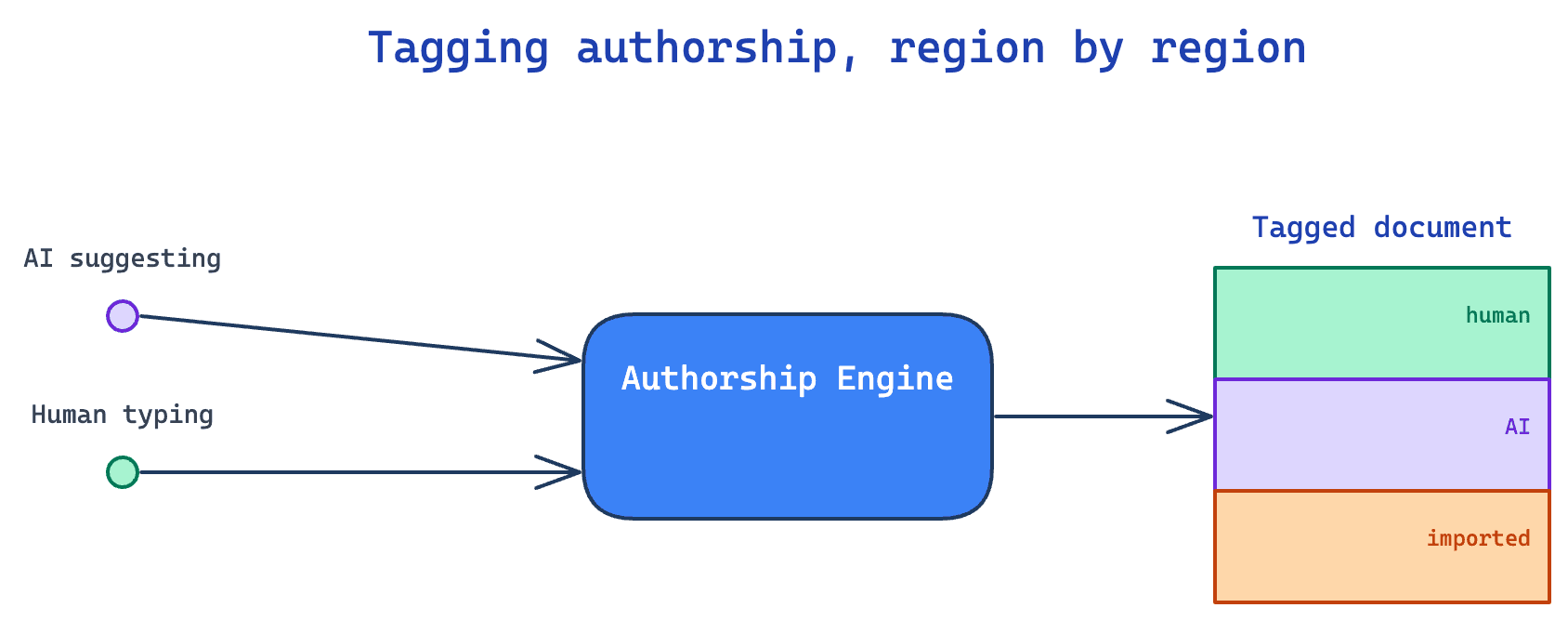
Two streams of input arrive at the editor at the same time: a human typing and an AI suggesting. Inside the editor, the authorship engine watches both. For every region of the document that gets created, it picks the right token (human, AI, mixed, or external) and stamps it on. The output is a single document in which every part of the page is labelled with who, or what, actually wrote it.
The issued claims (1, 9, and 14) all apply this same machinery in a particular setting: a first-party platform hosting user-uploaded video, with a third party filing complaints that the video is an unauthorized digital replica of them. In that workflow, the engine sits inside the platform's first-party mobile app. The camera-to-platform pipeline is sealed, meaning it is structured as a chain of custody where only the operating system, the first-party app, and the platform itself are allowed to write into the video stream, and anything that breaks the chain is treated as a change. The platform then uses the per-region tokens to decide what to do when the complaint arrives.
What the three independent claims actually protect
The twenty claims in the patent cluster around three independent claims that share one underlying idea.
Claim 1 describes a mobile-pipeline method. The platform keeps a sealed data pipeline (a controlled channel from the phone's camera to the platform's servers in which only the OS, the app, and the platform can write, so no third-party filter, codec, or capture SDK can modify the stream) from the user's phone camera to its own servers. The app on the phone tags any video it captures and edits with a non-artificial (human) authorship token. The platform hosts the video, and when a third party files an "unauthorized digital replica" complaint, the platform rules on the complaint with the token in hand. The dependent claims (2 through 8) sharpen this:
- Claim 2: deny the complaint if the video is fully human-authored.
- Claim 3: replace the offending region with AI-generated replacement video and tag the replacement as artificial when remediation is warranted.
- Claim 4: keep the video online through adjudication if it carries no AI tokens.
- Claim 5: enroll only the human-authored regions in a content-fingerprinting service, a hashing pipeline that turns each region into a compact identifier so the platform can spot re-uploads of the same bytes across billions of files without ever comparing the underlying media.
- Claim 6: anchor the tokens in a blockchain.
- Claim 7: tag any imported content as unknown provenance.
- Claim 8: corroborate the human attribution using contemporaneous sensor data.
Claim 9 is the platform-side system claim. The platform enrolls only human-tagged video into a fingerprinting service, refuses enrollment of AI-tagged regions, and rules on complaints using the tokens. Then comes the aggressive part: the platform can replace an offending region with AI-generated replacement video, or generate replacement content for an alleged copyright violation and keep the rest of the video online. The dependent claims cover tagging the replacement region as artificial (10), taking AI-tagged deepfake content down pending adjudication (11), per-region selective fingerprinting (12), and pulling the second-party mobile device into the claim (13).
Claim 14 is the editor-side method in its broadest form. The first party's application modifies three regions of a video: a human-edited one, an AI-edited one, and an externally imported one. Each gets tagged with the right token. The platform then hosts the video and rules on third-party claims against the full token mix. The dependent claims (15 through 20) layer fingerprinting (15), remediation (16), in-app playback (17), sensor corroboration (18), default-tagging of camera output (19), and pipeline integrity (20).
Read end to end, the issued claims describe a video host that has custody of the camera-to-app-to-platform pipeline, asks its users to edit inside its own app, and uses region-level authorship tokens to decide what to do about deepfake and copyright complaints. The much broader editor / IDE / image-editor disclosure sits in the description, supported by the specification but not yet claimed.
Why this is interesting beyond the bank
What stands out most about the patent is the assignee. U.S. Bank N.A. is not a software company and not a content platform. It is a top-five U.S. commercial bank, and that matters for two reasons. First, the bank's risk model already has a category for "synthetic data" and "natural data," with regulatory reasons to keep the two on different rails. A bank that can prove a piece of training data was human-authored has a different conversation about model-collapse risk than one that cannot. Second, the patent's claims read directly onto the compliance workflows every large enterprise is now being asked to build. Specifically: prove that a piece of evidence in a customer dispute was not AI-fabricated. Prove that a piece of marketing material flagged for review is genuinely attributable to a named human. Prove that a recording in a fraud case has not been silently spliced. A region-level authorship ledger addresses each of these in a single mechanism.
The claims reach further than the assignee's own line of business would suggest. The combination of sealed capture pipeline, first-party app edits, and token-aware third-party adjudication is the architecture of every short-video and social platform currently being pressured by courts, legislatures, and their own trust-and-safety teams to do something credible about deepfakes and unauthorized digital replicas, the same class of complaint claim 1 is built around. The patent is broad enough to read on most existing production stacks and narrow enough to defend in litigation. It is also the kind of IP that becomes very valuable if a single major ruling goes the right way.
For readers building in adjacent spaces, the patent is also a useful prior-art marker. Any new product that wants to label content as human or AI ends up asking the same three questions: how do you resist tampering, where do the labels live, and what counts as an edit in the first place. The patent sketches a defensible default at every one of those decision points.
Where the issued claims stop short, and what to watch next
All of that leaves an open question about scope. The 20 issued claims are all about a first-party platform hosting user-uploaded video with a third-party complaint workflow. The much broader text-editor, IDE, and image-editor disclosure is in the specification but not in the claims, which means the wider scope will have to land in the four pending continuation applications (19/346,008, 19/361,282, 19/379,892) and the parent PCT (PCT/US2025/012747) if it is to come through as enforceable IP.
The non-artificial authorship signal is also weaker than the claims imply. The patent assumes a clean signal from the human-interface device and a sealed camera-to-platform pipeline. In practice, on iOS and Android, the camera frame passes through the OS media stack, third-party SDKs, encoder and decoder pairs, and the app's own processing, any of which can be modified on a rooted device. The patent acknowledges the tamper-resistance problem in the body of the document, but the issued claims do not, on their face, recite a defense against a determined attacker.
There is also a fast-moving prior-art question. The deliberate-detectability features (odd syllable distributions, suffixed variable names, awkward identifiers) overlap with a wave of work on AI-output watermarking and provenance: C2PA content credentials, Google's SynthID, GLIDE, and several academic schemes for "model watermarking." A future patentability or infringement analysis will need to map these against that prior art carefully.
Most interesting, and narrowest, is the legal question this language leaves open. Claim 1's pipeline clause requires that "no editor other than the operating system of the mobile device, an application of the first party, and the platform" be allowed to modify the video stream. Apple and Google both reserve the right to read camera buffers for their own system features, and many real-world apps rely on third-party capture SDKs that sit in the data path. Whether that pipeline language reads on a typical iOS or Android social-video app is the kind of ambiguity that gets tested in court, not in the patent office. The answer will tell us a great deal about how much of the social-video stack this single patent can plausibly reach.
For now, the patent exists, it is broad, and it has the family structure that lets the assignee keep pushing the boundary outward for the next two decades. The technology it protects is, in plain language, the editor's conscience: the part of the software that finally tells the truth about who wrote what.
Sources
- US12462318B2. Content editing software via automatic and auditable authorship attribution. Google Patents record: https://patents.google.com/patent/US12462318B2/en
- USPTO Patent Center, application 19/241,881: https://patentcenter.uspto.gov/applications/19241881
- USPTO Assignment lookup for patent 12462318: https://assignment.uspto.gov/patent/index.html#/patent/search/resultFilter?searchInput=12462318
- Espacenet record: https://worldwide.espacenet.com/publicationDetails/biblio?CC=US&NR=12462318B2&KC=B2&FT=D
- Pre-grant publication US 2025/0315907 A1 (October 9, 2025), via Google Patents.
- US Copyright Office, Copyright Registration Guidance: Works Containing Material Generated by Artificial Intelligence, 88 Fed. Reg. 16190 (March 16, 2023). https://www.federalregister.gov/documents/2023/03/16/2023-05321/copyright-registration-guidance-works-containing-material-generated-by-artificial-intelligence
- Alemohammad et al., Self-Consuming Generative Models Go MAD, arXiv:2307.01850v1 (July 4, 2023). https://arxiv.org/abs/2307.01850
- Shumailov et al., AI Models Collapse when Trained on Recursively Generated Data, Nature 631, 755-759 (July 24, 2024). https://www.nature.com/articles/s41586-024-07566-y