The scaling inflection: a year with the 175-billion-parameter question
It is just over a year since a 72-page preprint from OpenAI quietly redrew the map of natural language processing. The paper, Language Models are Few-Shot Learners by Tom B. Brown and thirty co-authors, introduced a 175-billion-parameter autoregressive transformer called GPT-3 and a deceptively simple claim: scale up the same pre-training recipe used for GPT-2, hold the fine-tuning step, and let a handful of examples in the prompt do the work that thousands of labelled examples used to do. Few in May 2020 would have bet that this single decision, to remove gradient updates from the inference path, would become the dominant deployment pattern for the largest models in the world. Yet here we are.
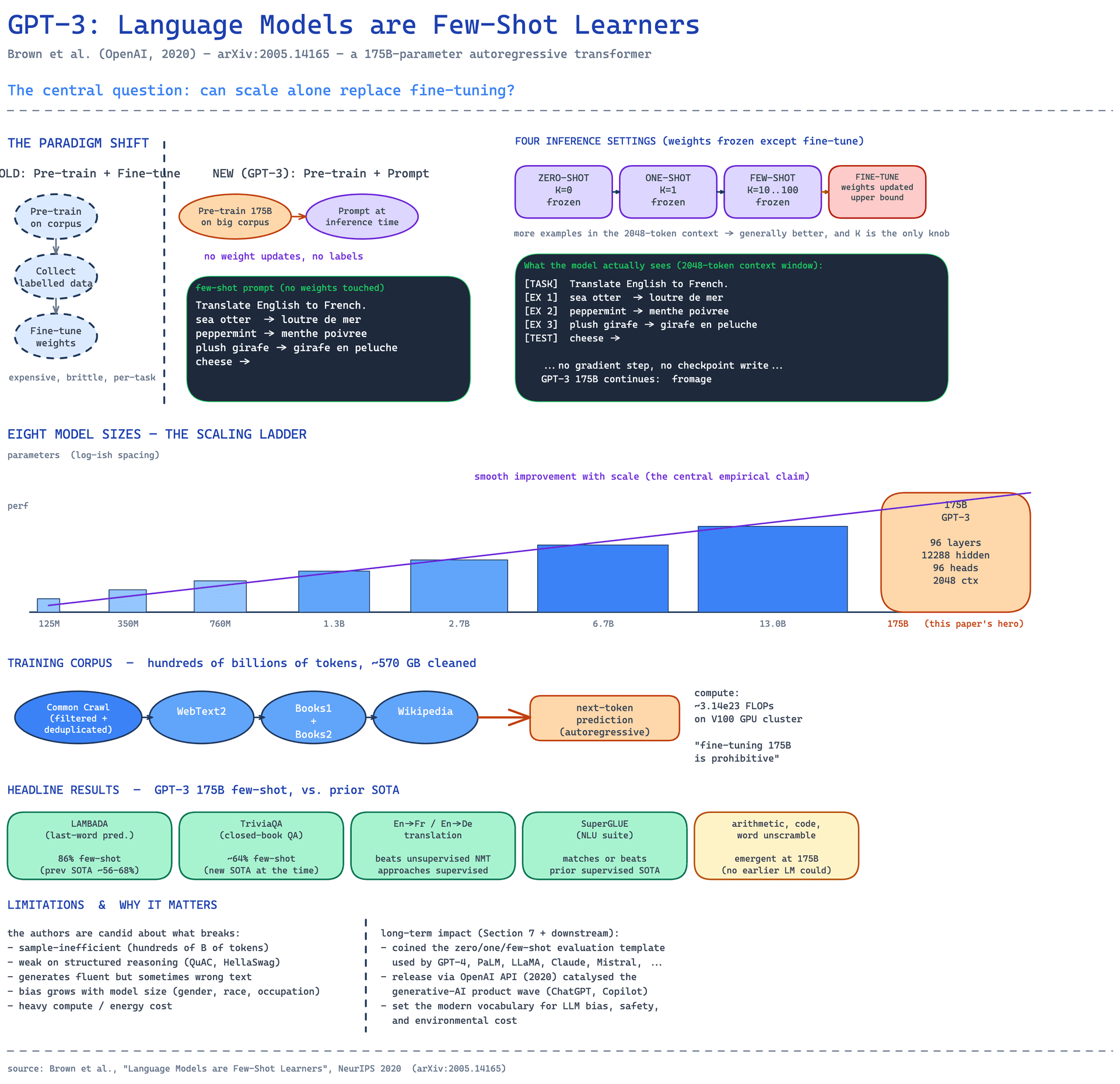
This briefing is a careful look at that paper. We will walk through what problem the paper actually solves, what "few-shot" means in the strict sense the authors intended, what the headline numbers really showed, and where the authors were unusually candid about the limits of their own creation. The diagram accompanying the explainer summarizes the training and inference loop in a single frame.
The paper at a glance
- arXiv ID: 2005.14165
- Title: Language Models are Few-Shot Learners
- Authors: Tom B. Brown, Benjamin Mann, Nick Ryder, Melanie Subbiah, Jared Kaplan, Prafulla Dhariwal, Arvind Neelakantan, Pranav Shyam, Girish Sastry, Amanda Askell, Sandhini Agarwal, Ariel Herbert-Voss, Gretchen Krueger, Tom Henighan, Rewon Child, Aditya Ramesh, Daniel M. Ziegler, Jeffrey Wu, Clemens Winter, Christopher Hesse, Mark Chen, Eric Sigler, Mateusz Litwin, Scott Gray, Benjamin Chess, Jack Clark, Christopher Berner, Sam McCandlish, Alec Radford, Ilya Sutskever, Dario Amodei
- Institution: OpenAI
- Venue: NeurIPS 2020 (December 2020 proceedings)
- Submission date: May 28, 2020
- Source: arXiv:2005.14165
The quiet inefficiency of fine-tuning at scale
The dominant recipe for putting a language model to work, going back to ELMo, ULMFiT, BERT, GPT, and GPT-2, has been the same in spirit: pre-train a transformer on a vast unlabelled corpus, collect a labelled dataset for the target task, and fine-tune the model on that dataset, often swapping in a new task-specific head. It is a recipe that has produced strong benchmark scores on GLUE, SuperGLUE, SQuAD, and a long list of classification, NLI, and QA tasks. It is also a recipe with three structural problems, and the GPT-3 paper opens by naming them plainly.
First, task-specific training data is expensive. Building a labelled dataset for every new task is a non-trivial engineering and annotation effort, and for many tasks there is simply not enough labelled data to fine-tune a 100M-plus-parameter model reliably. Second, fine-tuning can distort the model. Updating all of the parameters on a small dataset risks catastrophic forgetting of the broad capabilities the model acquired during pre-training, and the resulting model tends to be brittle under distribution shift. Third, and most philosophically pointed, humans do not actually need labelled examples for most tasks. A person reading "Translate English to French: cheese →" can produce "fromage" with no further instruction. The pre-train + fine-tune paradigm, by contrast, requires thousands of labelled examples per task.
The central question the paper asks is therefore simple to state and difficult to falsify: can we just scale up the pre-training step, remove fine-tuning entirely, and steer the model at inference time with a natural-language prompt containing a few examples? If the answer is yes, the implications for how language models get built, served, and priced are real and not small.
One idea, stated plainly: in-context learning as a substitute for fine-tuning
GPT-3 is, mechanically, an autoregressive, decoder-only transformer trained with the same next-token prediction objective as GPT-2. The architectural differences from its predecessor are minor. The model uses a 2048-token context window, the same as GPT-2, and the larger variants in the family introduce alternating dense and locally banded sparse attention patterns inspired by the Sparse Transformer. None of this is new in 2020. What is new is the size: 175 billion parameters, roughly two orders of magnitude beyond GPT-2's 1.5B, trained over a single pass on a multi-source corpus that combines a heavily filtered and deduplicated Common Crawl (60% of the weighted total) with WebText2, two large book corpora (Books1 and Books2), and English Wikipedia. The training run consumed around 300 billion tokens.
Two ideas do almost all of the conceptual work in the paper. The first is in-context learning as a substitute for fine-tuning. The model is shown a prompt of the form
Translate English to French.
sea otter → loutre de mer
peppermint → menthe poivrée
plush girafe → girafe en peluche
cheese →
and continues the pattern. There is no weight update; the demonstrations only live in the context window. The authors argue that as the model gets larger, its ability to use these in-context examples improves smoothly and dramatically, while small models barely benefit at all. The second idea is that the empirical scaling laws identified in Kaplan et al. 2020, which show test loss falling as a smooth power law in model size, dataset size, and compute, extend to downstream task performance, not just loss. The headline empirical claim of the paper is that they do.
Walking through the loop: from pre-training corpus to few-shot prompt
The training loop is the standard transformer language-modeling loop, scaled up. A document is sampled from the mixed corpus, tokenized, and presented to the model one chunk at a time. The model predicts the next token, the cross-entropy loss is computed, and the gradients are sharded across a large pool of V100 GPUs. The paper frames the total training cost in floating-point operations, on the order of 3.14 × 10²³ FLOPs for the 175B run, rather than in dollars, and the dollar figures that have circulated in the press (single-digit to low-double-digit millions) are external estimates. The key sentence in the methods section is the one noting that fine-tuning the 175B is computationally prohibitive, which is the explicit reason the paper commits to the no-fine-tuning evaluation protocol.
The evaluation protocol is the second half of the story and is worth being precise about. The paper reports results in three (occasionally four) settings for every task:
- Zero-shot: the prompt contains a natural-language description of the task and nothing else.
- One-shot: the prompt contains the description plus a single example of input → output.
- Few-shot: the prompt contains the description plus K examples, typically 10 to 100, bounded by the 2048-token context.
- Fine-tune (upper bound): the paper fine-tunes only the smaller models and reports those numbers as a ceiling. The 175B is never fine-tuned in the main results.
What is worth paying attention to, and what the paper hammers home with figure after figure, is that on most tasks the order zero-shot ≤ one-shot ≤ few-shot holds, and within each setting larger is better, often smoothly and without obvious saturation. The model is not being trained to do each task. It is being shown a few examples and continuing the pattern, and the quality of that continuation improves with scale.
What the numbers actually showed
The paper evaluates on more than twenty NLP tasks, and the headline results have aged into the canonical reference set for the field. On LAMBADA, a last-word-prediction task designed to require broad context, the 175B zero-shot setting reaches 76.2% accuracy, an 8% gain over the prior state of the art around 68%, and the few-shot setting reaches 86.4%, an 18% jump. This is the cleanest single demonstration in the paper that scale alone, without architectural change, can produce large qualitative gains. On closed-book question answering, where the model must answer trivia questions without retrieved context, the 175B few-shot posts 71.2% on TriviaQA (outperforming the fine-tuned T5-11B at the time) and 29.9% on Natural Questions, which is competitive with the closed-book state of the art for that benchmark. On translation, the few-shot 175B outperforms unsupervised neural machine translation baselines on several language pairs and approaches but does not match supervised state of the art; the paper also introduces a new low-resource unsupervised MT benchmark and reports strong results there.
On SuperGLUE, the few-shot 175B approaches and in some sub-tasks matches or exceeds the prior supervised state of the art, with the paper's "SuperGLUE Adapted" variant making the comparison fairer. On reading comprehension (QuAC, CoQA, DROP, SQuAD v2) the picture is mixed: often better than prior zero-shot baselines, sometimes within striking distance of supervised state of the art, sometimes not. On commonsense reasoning (HellaSwag, PIQA, StoryCloze, Winogrande, ARC) the result is more sober. HellaSwag in particular shows only modest gains (78.1% one-shot, 79.3% few-shot, still 6 points below the fine-tuned ALUM leader) and the authors flag it as a clear weakness where humans remain well above the model. PIQA, on the other hand, is a quiet success: the 175B sets a new state of the art at 82.8% few-shot.
The most-quoted results, however, are the qualitative ones. The 175B is shown to perform arithmetic, word unscrambling, SAT-style analogy questions, and simple code synthesis in the few-shot setting, tasks at which earlier language models could not succeed at all. The paper's news-article generation and made-up-word-to-definition sections are the most-reproduced demonstrations. On the news-article study, 80 US subjects were asked to judge whether ~200-word articles were written by humans or by the 175B model. Mean accuracy was 52%, only slightly better than chance. That is the number to sit with: a model fluent enough to fool people on a coin flip, and the authors say so plainly.
Why the field treated this paper as a turning point
Three contributions explain why GPT-3 became the inflection point between "language model as a research curiosity" and "large language model as a product paradigm." First, the paper demonstrated that scaling alone produces qualitatively new behavior. In-context few-shot learning emerges smoothly with scale rather than being a special architectural trick, and that finding is what justified the subsequent wave of ever-larger models at Google, Microsoft, NVIDIA, and elsewhere. Second, the paper set the template for LLM evaluation. The zero/one/few-shot protocol became the de facto standard for nearly every subsequent LLM release, and the "scaling plots" that headlined the paper are the most reproduced figures in the literature. Third, the paper catalyzed the LLM product wave. The 175B model was made available through the OpenAI API on 11 June 2020 (the private beta opened in late May 2020), and the paper's qualitative demos are widely credited with triggering the explosion of generative-AI startups, prompt-engineering tooling, and downstream applications that were visible by mid-2021. Microsoft announced an exclusive license to GPT-3 in September 2020, which is its own kind of milestone.
There is also a quieter fourth contribution that deserves more attention than it gets. The paper's Section 7, on broader impacts, is unusually candid. It contains a substantial bias audit showing that GPT-3 (especially the 175B) reflects gender, racial, religious, and occupational biases present in its training data, and demonstrates that the bias tends to grow with model size. It contains a back-of-the-envelope estimate of the energy and environmental cost of training. It contains an explicit discussion of dual-use risk, including spam, phishing, abuse of legal and governmental processes, fraudulent academic essay writing, social engineering pretexting, and bias in automated systems. The concurrent Bender et al. 2020 "Stochastic Parrots" essay, which appeared shortly after the GPT-3 preprint, sharpened many of these concerns, and the vocabulary the two papers together established — bias audits, energy cost reporting, dual-use framing — is becoming the dominant critical framework for the LLM discourse.
Where the authors were honest about the limits
The paper's Section 6 ("Limitations") reads as an accurate forecast of the problems the field is now trying to solve. GPT-3 is the opposite of sample-efficient. The headline numbers rely on training on hundreds of billions of tokens, and the model is still often beaten by smaller fine-tuned models on narrowly defined tasks. On tasks that require careful structured reasoning, including certain reading comprehension comparisons and fill-in-the-blank adversarial datasets (ANLI, WiC, RTE), GPT-3's gains are small or non-existent, and the authors flag this as a major open problem. The text generation, while fluent, is sometimes repetitive, sometimes factually wrong, and sometimes plausible-sounding nonsense; the 52%-at-chance human-discrimination study on news articles is the most quoted acknowledgment of this. The bias audit in Section 7.1, which includes the "Man is to Computer Programmer as Woman is to Homemaker" style completions showing clear occupational gender skew, is already shaping the fairness-and-LLMs research agenda.
What the paper does not contain is also worth being precise about, because later work is often projected back onto it. The original 175B is not fine-tuned with reinforcement learning from human feedback. It is not instruction-tuned. It is not trained on code in a way that produces Codex. It does not use retrieval augmentation. It does not have a 32K or 100K context window. The 2048-token context of GPT-2 carries over unchanged. The release mechanism is the OpenAI API; the open-source repository at openai/gpt-3 hosts the paper and a few evaluation notebooks, but not the model weights. Anything one reads in mid-2021 about RLHF, instruction tuning, retrieval, or extended-context LLMs is from later, separate work, and conflating those with the original paper is a category error.
The reasonable question to ask a year later, as the cost of training frontier models rises and the energy and equity concerns of Section 7 have become harder to ignore, is whether the scaling trajectory the paper inaugurated can be sustained on its current terms. The paper itself does not answer that question, and the candid acknowledgment of the cost, the bias, and the dual-use risk is the strongest argument that the authors understood what they were handing the field.
Sources
- Brown, T. B., Mann, B., Ryder, N., et al. (2020). Language Models are Few-Shot Learners. arXiv:2005.14165. https://arxiv.org/abs/2005.14165
- Brown, T. B., et al. (2020). Full text PDF. https://arxiv.org/pdf/2005.14165
- Brown, T. B., et al. (2020). Advances in Neural Information Processing Systems 33 (NeurIPS 2020). https://proceedings.neurips.cc/paper/2020/hash/1457c0d6bfcb4967418bfb8ac142f64a-Abstract.html
- Brown, T. B., et al. (2020). NeurIPS 2020 proceedings PDF. https://proceedings.neurips.cc/paper/2020/file/1457c0d6bfcb4967418bfb8ac142f64a-Paper.pdf
- OpenAI. (2020). openai/gpt-3 GitHub companion repository. https://github.com/openai/gpt-3
- OpenAI. (2020). OpenAI API announcement (11 June 2020). https://openai.com/blog/openai-api
- Kaplan, J., McCandlish, S., Henighan, T., Brown, T. B., Chess, B., Child, R., Gray, S., Radford, A., Wu, J., and Amodei, D. (2020). Scaling Laws for Neural Language Models. arXiv:2001.08361.
- Radford, A., Wu, J., Child, R., Luan, D., Amodei, D., and Sutskever, I. (2019). Language Models are Unsupervised Multitask Learners. OpenAI Technical Report.
- Bender, E. M., Gebru, T., McMillan-Major, A., and Shmitchell, S. (2020). On the Dangers of Stochastic Parrots: Can Language Models Be Too Big? Proceedings of FAccT 2020.