Two Halves and a Whole: How Dent's Designer's Guide Made Hybrid Encryption Boring
Most working cryptographers can sketch a hybrid encryption scheme on a napkin. The sender picks a fresh symmetric key, encrypts the message with AES (or 3DES, depending on the decade), then encrypts the symmetric key with RSA. That recipe has quietly underwritten PGP, TLS, IPSec, and S/MIME for the past three decades. The trouble is that, for most of that history, the security arguments behind the recipe were ad hoc, and several textbook-style hybrids turned out to be quietly broken. Boneh, Joux, and Nguyen's 2000 paper showed why: with no preprocessing of the plaintext, both textbook ElGamal and textbook RSA encryption fail to hide the message from an attacker who can mount a related-message or chosen-ciphertext attack on the homomorphic structure of the raw operation.
What changed the conversation was a small body of work in the early 2000s that turned hybrid encryption from folk practice into a theorem. The cleanest writeup of the framework is Alexander W. Dent's 2003 paper, A Designer's Guide to KEMs, published in the proceedings of the 9th IMA International Conference on Cryptography and Coding (LNCS 2898, IACR ePrint 2002/174). The paper is short, pedagogical, and relentlessly practical. It is the document that turned the KEM-DEM split into the default way to reason about public-key encryption for the two decades of standards work that followed.
This briefing walks through what the paper does, why its composition theorem is more useful than it first looks, and where the construction sits in the post-quantum conversation playing out in 2022.
The paper at a glance
- Title: A Designer's Guide to KEMs
- Author: Alexander W. Dent, Royal Holloway, University of London
- Venue: Cryptography and Coding, 9th IMA International Conference, Cirencester, UK, December 16-18, 2003, Proceedings
- Publisher: Springer, Lecture Notes in Computer Science, volume 2898
- DOI: 10.1007/978-3-540-40974-8_12
- IACR ePrint: 2002/174 (received November 2002, last revised October 2005)
- Status: peer-reviewed conference paper; ePrint carries five revisions with technical errata corrected
- License on ePrint: CC BY 4.0
Why textbook hybrids kept surprising us
Asymmetric primitives (RSA, ElGamal, Rabin) are slow and can only act on short, structured inputs. Symmetric primitives (AES, 3DES) are fast and accept arbitrary-length messages, but they need a shared key that someone has to agree on first. Real systems have always used the asymmetric primitive to ship a fresh symmetric key, then the symmetric primitive to do the bulk work. The awkward part is that the security proof for the resulting scheme has historically been glued together by hand, and the wrong glue produces a broken scheme.
Dent's paper, following Cramer and Shoup, formalizes the split into two named pieces. A KEM (Key Encapsulation Mechanism) is an asymmetric primitive that, given a receiver's public key, generates a random symmetric key together with an encapsulation of that key. A DEM (Data Encapsulation Mechanism) is a symmetric authenticated encryption scheme that takes a message and a symmetric key. The hybrid PKE is the obvious combination: run the KEM, run the DEM with the resulting key, ship the two ciphertexts concatenated.
The cleanest payoff of this split is a single sentence that the paper makes precise: if the KEM is IND-CCA-secure and the DEM is IND-CCA-secure, then the combined PKE is IND-CCA-secure. That is the composition theorem. It is what lets a protocol designer swap in a new RSA-KEM or a lattice KEM without re-proving the whole scheme from scratch, as long as the underlying symmetric layer keeps its authenticated-encryption guarantees.
The KEM and the DEM, sitting in a tree
The KEM-DEM split does something subtle that is easy to miss on first reading. It separates the asymmetric security claim (the KEM is indistinguishable from random, even under chosen-ciphertext attack) from the symmetric security claim (the DEM is an authenticated encryption scheme, with its own key and integrity guarantees). Each half can be studied, attacked, and substituted on its own terms.
For a long time, hybrid schemes in the wild had this property implicitly. PGP encrypted the session key with RSA, then encrypted the message with a symmetric cipher. TLS 1.0 up through 1.2 used RSA key transport or Diffie-Hellman for the asymmetric half, then a stream or block cipher for the bulk data. What the KEM-DEM framework adds is the formal vocabulary to describe what those protocols were doing, prove they were doing it correctly, and to flag the failure modes that show up when someone gets clever with the symmetric part.
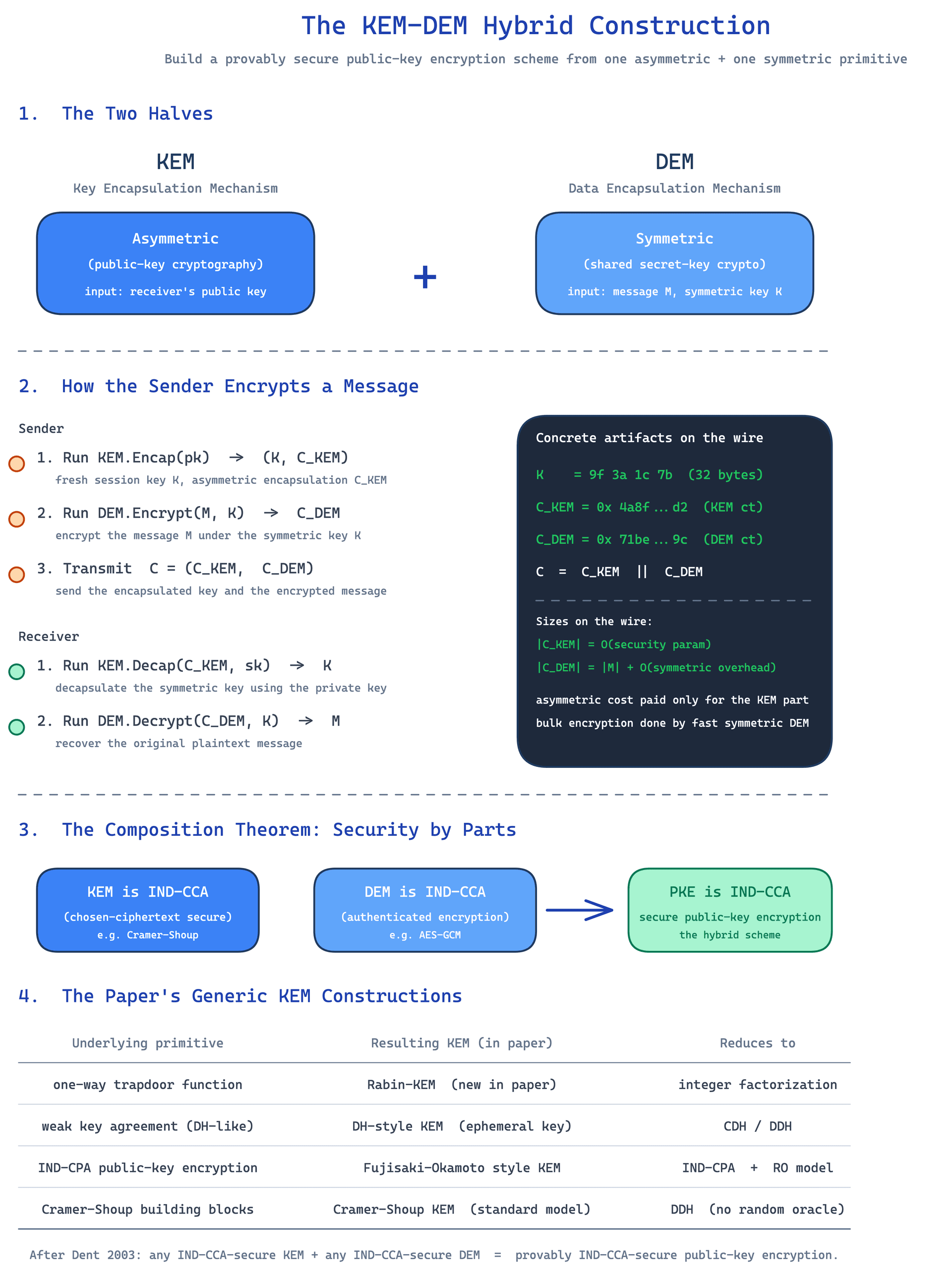
The diagram lays the whole story out in one frame. Section 1 sets up the two halves: a KEM is asymmetric cryptography built around a public key, a DEM is symmetric cryptography built around a shared key. Section 2 walks the wire format. The sender runs KEM.Encap to get a fresh key K and encapsulation C_KEM, runs DEM.Encrypt on the message under K to get C_DEM, and ships C = (C_KEM, C_DEM). The receiver reverses the two steps. The dark box on the right shows what actually appears on the wire: K is 32 bytes, C_KEM is on the order of the security parameter, C_DEM is roughly the message length plus symmetric overhead. Section 3 is the composition theorem in its simplest form: two IND-CCA-secure boxes plus an arrow equals an IND-CCA-secure hybrid. Section 4 lists the four generic KEM constructions the paper builds out of lower-level primitives.
The actual constructions in the paper
Dent is generous about what counts as a usable starting point. The paper presents four generic KEM constructions, each reducing a different low-level assumption to a full IND-CCA KEM in the random oracle model.
The first construction starts from a one-way trapdoor function. Pick a random r, hash it, apply the OWTF to get an encapsulation. Derive the key K from a hash of r (or equivalently from a hash of the OWTF preimage). The concrete instance in the paper is a KEM based on modular squaring, which Dent calls Rabin-KEM. The reduction is to integer factorization under the random oracle model, and the paper argues that the construction is more efficient than padding-based RSA-KEMs because the underlying primitive is a permutation rather than a padded non-bijection.
The second construction lifts a weak key-agreement protocol into a KEM. The classic example is Diffie-Hellman: the encapsulation is the sender's ephemeral public key, the symmetric key is the DH shared secret. Security reduces to CDH or DDH depending on the variant.
The third construction turns an IND-CPA-secure public-key encryption scheme into a KEM. The idea is to encrypt a freshly chosen symmetric key with the IND-CPA PKE, and the resulting scheme is IND-CCA in the random oracle model via a Fujisaki-Okamoto-style transformation. This is the generic pattern that most modern post-quantum KEM submissions are proving security for, and it is the construction that runs through the lattice-based, code-based, and isogeny-based candidates that have come out of the NIST process.
The fourth construction discusses Cramer-Shoup-style KEMs that achieve IND-CCA in the standard model. The trade-off is concrete: the standard-model construction is heavier than the random-oracle one, and protocol designers can pick which side of that trade-off they want to be on.
The paper also spends a chapter connecting the KEM-DEM framework to the older RSA-OAEP and RSA-OAEP+ literature, showing that those schemes can be retrofitted into the KEM-DEM view without any loss of confidence. That is the move that turned RSA-OAEP from a "we hope this is secure" construction into a "we know this is IND-CCA-secure against any adversary that does not break the RSA assumption in a strong sense" construction.
The composition theorem in plain words
Strip the paper to its core claim and you get the composition theorem. A hybrid PKE built by concatenating the ciphertexts of an IND-CCA-secure KEM and an IND-CCA-secure DEM is itself IND-CCA-secure. The proof is short: any attack on the hybrid can be converted into an attack on one of the two components. The asymmetric half hides the session key from the adversary, and the symmetric half, with its integrity tag, makes ciphertext modification detectable.
The practical consequence is that a protocol designer can treat the KEM and the DEM as black boxes. Pick any authenticated encryption scheme for the symmetric half (AES-GCM, ChaCha20-Poly1305, OCB, whatever is current and vetted) and any IND-CCA KEM for the asymmetric half (RSA-OAEP, ECIES, Cramer-Shoup, Kyber), then concatenate the two ciphertexts. The result is a public-key encryption scheme that comes with a clean security proof, and the proof does not need to be redone each time a component is swapped.
This is also why KEM-DEM is the structure used for hybrid post-quantum TLS. The IETF TLS working group is working through draft-ietf-tls-hybrid-design in 2022, and the typical construction runs an X25519 KEM and a Kyber KEM in parallel, derives a hybrid session key from both shared secrets, then hands that key to the standard TLS AEAD. The KEM-DEM vocabulary is what makes that composition defensible.
Why this paper still matters in 2022
Twenty years after publication, the paper is still being cited in submissions to the NIST post-quantum standardization process. The reason is structural. The four post-quantum KEM finalists (Kyber, NTRU, Saber, and Classic McEliece) are all designed to fit the KEM abstraction, and the security arguments in their submission packages are written in the language of IND-CCA and IND-CPA that the paper formalizes. The lattice KEMs use a Fujisaki-Okamoto-style transform from an IND-CPA public-key encryption to an IND-CCA KEM, which is the third generic construction in the paper. The code-based and isogeny-based candidates follow the same pattern.
This matters in 2022 because NIST has just selected the first batch of post-quantum standards. On July 5, 2022, NIST announced the selection of CRYSTALS-Kyber for public-key encapsulation, alongside CRYSTALS-Dilithium, FALCON, and SPHINCS+ for digital signatures. The conversation has moved from "which KEM do we trust" to "how do we deploy it alongside our existing classical primitives". The deployment answer is almost always some form of KEM-DEM, with the post-quantum KEM running in parallel with (or concatenated to) a classical KEM like X25519, and the resulting session key feeding a standard AEAD.
The paper is also a useful reference for the limits of the framework. The composition theorem requires an IND-CCA-secure KEM and an IND-CCA-secure DEM. If the symmetric half is only IND-CPA-secure (an unauthenticated mode like CBC or CTR), the composition breaks down. The padding-oracle and Lucky Thirteen attacks on TLS-CBC record layers in the early 2010s are the cautionary tale: TLS at the time used MAC-then-encrypt with CBC, with the MAC handled outside any AEAD. The padding-oracle attacks (Vaudenay 2002, later Bleichenbacher-style variants, BEAST 2011, Lucky Thirteen 2013) showed that running a separate MAC alongside CBC, without the integration that an AEAD provides, leaks enough information for a network adversary to recover plaintexts. The composition argument was not applied at the record layer, and the framework that would have caught that mistake had not been adopted in TLS 1.0/1.1. If you are designing or reviewing a hybrid scheme in 2022, that history is worth keeping in mind.
What the framework does not solve
The framework is modular, but it is not magic. A few caveats are worth keeping in mind.
First, the random-oracle model is doing real work in the Rabin-KEM and the IND-CPA-to-IND-CCA transforms. Standard-model IND-CCA KEMs exist (Cramer-Shoup is the canonical example), but they are heavier, and most post-quantum KEMs in 2022 still rely on random-oracle proofs. Moving to a post-quantum KEM without a careful look at which properties the underlying PKE actually has is a recipe for trouble.
Second, the composition theorem requires the symmetric half to be IND-CCA-secure, which in practice means an authenticated encryption scheme with nonces handled correctly, keys of the right length, and integrity tags that have not been truncated. The KEM-DEM framework assumes the symmetric primitive is honest. If the AEAD is broken (think AES-GCM with reused nonces, or a custom mode with a non-adversarial but realistic implementation bug), the composition theorem says nothing.
Third, the framework as written is for single-recipient encryption. Multi-recipient or broadcast settings, where one encapsulation is sent to many users, are out of scope. Those are an active research area, and the usual pattern is to layer broadcast encryption on top of the KEM rather than reuse the single-recipient theorem directly.
Finally, the paper focuses on the encryption side. Authenticated key exchange, which is what TLS 1.3 actually needs, has its own composition story (the NAE-MQXDH and HMQV literature, the Signal X3DH protocol from Marlinspike and Perrin in 2016, the ongoing IETF discussion of hybrid KEMs for TLS), and the KEM-DEM framework is one ingredient rather than the whole recipe.
Open questions and where the conversation is going
The interesting research questions in 2022 are mostly about composition and deployment rather than the basic KEM-DEM theorem. Three threads are worth flagging.
The first is hybrid classical-plus-post-quantum KEMs. The IETF draft on hybrid key exchange in TLS 1.3 is iterating through design choices (concatenate shared secrets, run KEMs in parallel, derive the session key with a labeled hash) and the security arguments are written in exactly the KEM-DEM vocabulary that Dent's paper set out. The same pattern is being applied to SSH and IPsec. The open design question is whether to treat the hybrid KEM as a single primitive (with its own IND-CCA security claim) or as a black-box composition (with the security claim following from the IND-CCA security of each half). The latter is closer to the paper's spirit, and most current proposals lean that way.
The second is the tighter study of CCA security for KEMs in the quantum random oracle model. The Fujisaki-Okamoto transformation that lifts an IND-CPA PKE to an IND-CCA KEM has a known security loss in the quantum setting, and several recent papers (including work by Bindel, Hamburg, and Hövelmanns, building on earlier work by Boneh, Dagdelen, Fischlin, Lehmann, Schaffner, and Zhandry) tighten the bounds or propose variants with smaller loss.
The third is the search for cleaner standard-model constructions. The IND-CCA-secure KEMs that do not need the random oracle are heavier than their random-oracle counterparts, and post-quantum candidates that aim at the standard model (older isogeny-based proposals such as CSIDH, and code-based rank-metric schemes such as ROLLO and RQC) are still at the prototype stage as of mid-2022, with none of them advancing to the NIST fourth round. Whether any of them will end up both efficient and standard-model-secure is an open bet, not a settled outcome.
Sources
- Alexander W. Dent, A Designer's Guide to KEMs, IACR Cryptology ePrint Archive, Paper 2002/174, last revised October 2005: https://ia.cr/2002/174
- Springer chapter, LNCS 2898, DOI 10.1007/978-3-540-40974-8_12: https://link.springer.com/chapter/10.1007/978-3-540-40974-8_12
- DBLP record: https://dblp.org/rec/conf/ima/Dent03.html
- Dan Boneh, Antoine Joux, and Phong Q. Nguyen, Why Textbook ElGamal and RSA Encryption Are Insecure, ASIACRYPT 2000, LNCS 1976: https://link.springer.com/chapter/10.1007/3-540-44448-3_3
- NIST PQC Standardization Process, Announcing Four Candidates to be Standardized, Plus Fourth Round Candidates (July 5, 2022): https://csrc.nist.gov/News/2022/pqc-candidates-to-be-standardized-and-round-4
- NIST IR 8413, Status Report on the Third Round of the NIST Post-Quantum Cryptography Standardization Process (updated June 2022): https://nvlpubs.nist.gov/nistpubs/ir/2022/NIST.IR.8413-upd1.pdf
- Douglas Stebila, Scott Fluhrer, and Shay Gueron, Hybrid key exchange in TLS 1.3, IETF draft-ietf-tls-hybrid-design: https://datatracker.ietf.org/doc/draft-ietf-tls-hybrid-design/
- Moxie Marlinspike and Trevor Perrin, The X3DH Key Agreement Protocol, Signal specifications (2016): https://signal.org/docs/specifications/x3dh/
- NIST IR 8545, Status Report on the Fourth Round of the NIST Post-Quantum Cryptography Standardization Process (2025): https://nvlpubs.nist.gov/nistpubs/ir/2025/NIST.IR.8545.pdf
This briefing curates a foundational cryptographic construction and explains why it still shapes the way we build public-key encryption in 2022. Found it useful? Forward it to a colleague who is reasoning about hybrid post-quantum deployments. Views and commentary are original; sources are linked inline.