Canton Network: The Blockchain Built Like the Internet
In early 2023, a group of banks, exchanges, and technology firms placed a quiet bet on the future of financial infrastructure. Goldman Sachs, Deutsche Borse, Microsoft, BNP Paribas, Broadridge, and more than two dozen others announced their backing of a new public blockchain network called Canton. The pitch sounded simple: a "network of networks" for smart contract applications. But beneath the slogan sits a real reconsideration of how distributed ledgers should work when the participants are regulated institutions handling sensitive data. These are not pseudonymous traders swapping tokens where anyone can watch.
The key document laying out this vision is the Canton Network white paper, published by Digital Asset and updated in January 2024. It is a technical industry white paper from the team that built both the Daml smart contract language and the Canton synchronization protocol. What makes it worth close attention is the problem it tackles head-on. Most public blockchain advocates prefer to ignore it: the overwhelming majority of the world's financial assets still live off-chain, and stubbornness is not the reason. Existing public chains force a choice between transparency and control that regulated institutions cannot accept.
This briefing unpacks the Canton Network architecture, its core technical claims, and why institutions that collectively move trillions of dollars every day are treating this design as a candidate for the next generation of financial market infrastructure.
The Paper at a Glance
- Title: Canton Network: A Network of Networks for Smart Contract Applications
- Publisher / Authors: Digital Asset (Digital Asset Canton Team)
- Publication Date: Announced May 2023; updated January 2024
- Document Type: Technical industry white paper
- Source: Canton Network White Paper
- Related Technical Paper: Canton: A Daml based ledger interoperability protocol
Why Wall Street Still Treats Public Blockchains as Toys
The white paper opens with a blunt assessment of why smart contract networks have failed to win over financial institutions. The authors argue that chains like Ethereum carry three structural constraints that make them unsuitable for institutional finance.
The first problem is transparency. On Ethereum, every transaction is visible to every node. A securities lending deal between Goldman Sachs and a counterparty would be readable by anyone running a node. For institutions governed by confidentiality agreements, data protection laws, and competitive secrecy, this is not a minor inconvenience. It disqualifies the platform outright.
The second problem is resource contention. All applications on Ethereum share a single global pool of computational resources. When CryptoKitties consumed over 12% of network transactions in late 2017, every other application on Ethereum paid the price in higher fees and slower confirmations. The white paper argues that this architecture treats a billion-dollar settlement application and a speculative NFT mint as equals fighting for the same block space. Financial institutions need predictable infrastructure, not a shared highway where one user's traffic jam becomes everyone's delay.
The third problem is control. On public proof-of-stake chains, asset issuers surrender control of their assets to a pool of pseudonymous validators. From a regulatory standpoint, this raises hard questions about custody, compliance, and legal enforceability. An investment bank cannot hand control of client assets to an anonymous validator set and hope for the best.
The paper also targets the proposed solutions. Layer-2 rollups, cross-chain bridges, and sidechains add architectural complexity without solving the root problem. The white paper points to bridge hacks like Ronin (~570 million), Wormhole (200 million) as evidence that these workarounds introduce new attack surfaces instead of fixing the underlying design.
A Network of Networks, Not a One-Size-Fits-All Chain
The Canton Network's core insight comes from the most successful public network in history: the Internet. The Internet is a mix of many different kinds of services. Wikipedia (fully public) and gated banking portals (fully private) coexist on the same infrastructure. High-volume, low-value services share the network with low-volume, high-value services. Each application provider controls its own permissions, fees, scale, and service levels. The Internet scales horizontally because each application adds its own resources. Growth in one service does not starve the others.
Canton applies this same philosophy to blockchain. Instead of forcing all applications through a single global ordering service, Canton lets each application define its own privacy model, governance rules, scaling strategy, and infrastructure. Applications are not competitors for shared block space. They are independent networks that can interoperate when needed.
The mechanism for this interoperability is the Canton protocol, which sits on top of Digital Asset's Daml smart contract language. Daml is a functional programming language built specifically for multi-party applications with programmable privacy. In a Daml contract, every piece of data explicitly defines who can see it (observers) and who is bound by it (signatories). Data is confidential by default. Privacy is not an afterthought bolted onto a transparent system. Digital Asset built it into the language itself.
How Canton Stitches Private Ledgers Into One Virtual Whole
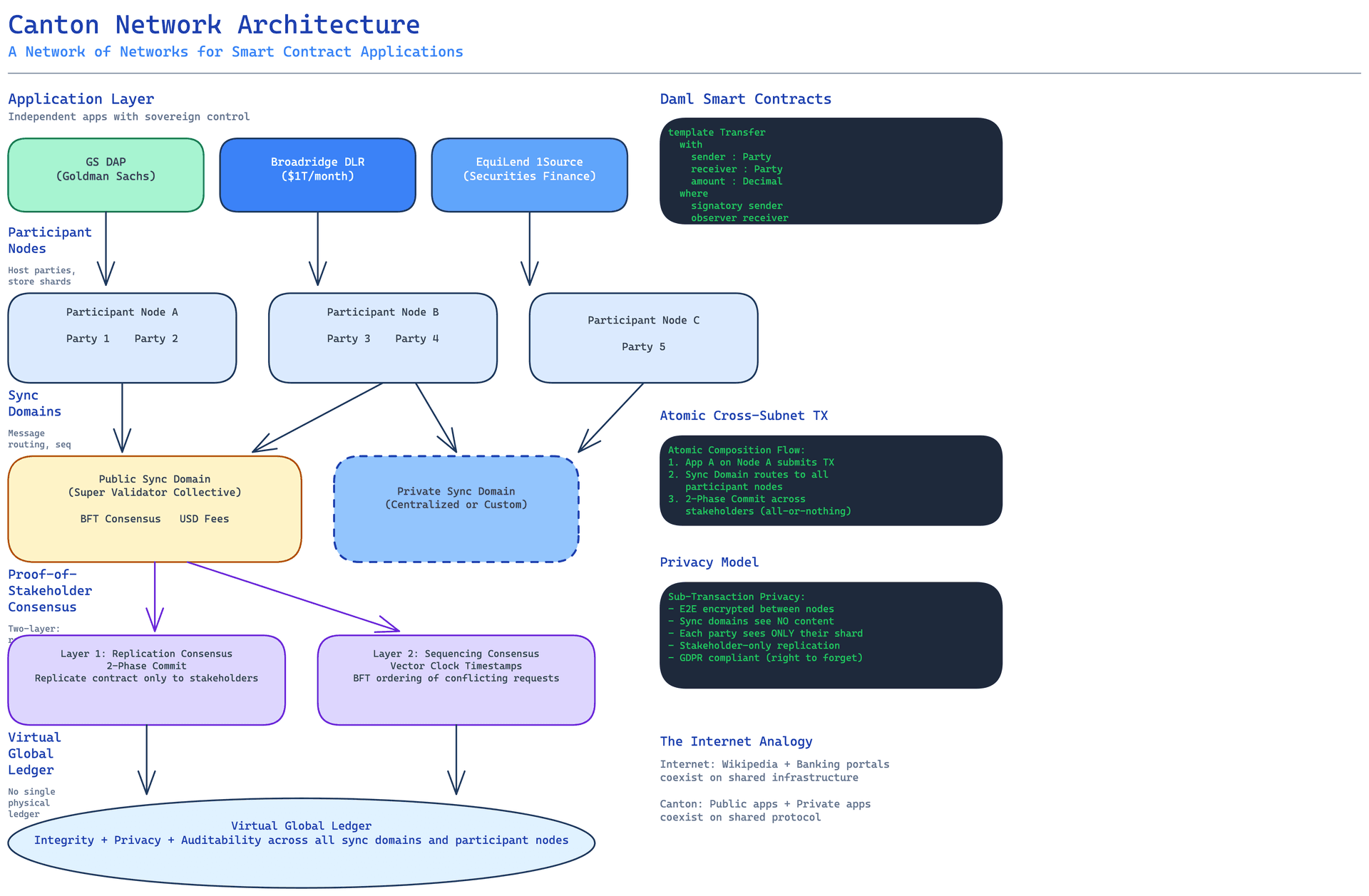
Canton works through three building blocks: participant nodes, sync domains, and the virtual global ledger.
Participant Nodes
Participant nodes are the compute entities that host parties on the network. A single node can host multiple parties. A bank might run one node that serves several of its trading desks. Each node stores only the ledger data relevant to the parties it hosts. This marks a major departure from traditional blockchain: there is no global state replicated to every node. Instead, each node holds a shard of the ledger.
Sync Domains
Sync domains are the messaging and ordering layers that connect participant nodes. A sync domain routes encrypted messages between nodes, assigns a consistent transaction order, and confirms transaction commits. Critically, sync domains do not see transaction contents. All data between nodes is end-to-end encrypted. The sync domain sees only routing metadata, not the actual contracts or values being exchanged.
Sync domains can be public or private. The public Canton Network is anchored by a permissionless virtual sync domain operated by a Super Validator Collective (SVC), a group of independent companies that charge fixed USD fees for bandwidth. But any participant can also operate a private sync domain with its own trust assumptions, governance, and fee structure.
A firm can run a centralized sync domain internally, connect it to the public network when needed, and transfer workflows between domains without losing the integrity guarantees of the broader network.
The Virtual Global Ledger
The virtual global ledger is the conceptual unification of all these shards. Participant nodes can connect to multiple sync domains and move workflows between them. The result is a single virtual ledger that spans the entire network. This ledger does not exist in any one physical database. It is the result of the Canton protocol's guarantees: every properly functioning node maintains a consistent subset of a single global ledger, even though no node ever sees the whole thing.
Proof-of-Stakeholder: Consensus Without the Waste
Digital Asset calls its consensus mechanism "proof-of-stakeholder consensus." It is a two-layer design that directly addresses the scalability and privacy problems of traditional consensus.
Layer 1: Replication Consensus
When a transaction is submitted, a two-phase commit protocol replicates the resulting contract only to the stakeholders of that contract. A derivative trade between Party A and Party B gets replicated only to their respective participant nodes, not to the entire network. This works much like sharded databases handle distributed transactions, and it represents a sharp break from Ethereum's model where every node replicates every state change.
Layer 2: Sequencing Consensus
When two transactions conflict (for example, two parties try to exercise the same contract simultaneously), a sequencing protocol assigns an order using vector clock timestamps. In public sync domains, this sequencing runs as a replicated state machine secured by a Byzantine Fault Tolerant (BFT) consensus algorithm. The result is a predictable total order on conflicting requests without requiring the entire network to agree on every single transaction.
This two-layer approach enables Canton's claim of horizontal scalability. Each application only replicates state to its stakeholders and only sequences when conflicts arise, so the network's throughput is not bounded by a single global consensus bottleneck. Applications scale independently.
Fifty Billion Dollars a Day Says This Is Not Just Theory
The white paper makes several strong claims, and it backs at least one of them with hard numbers. As of early 2023, financial institutions were already transacting over $50 billion daily on limited-access subnets of the Canton Network. That is not testnet activity or proof-of-concept volume. It is production settlement flow from regulated firms.
Here are the four claims the paper makes, and what they mean in practice.
Privacy by Design
The network provides what the paper calls "the privacy of a private blockchain on a public network." Sub-transaction privacy means that in a complex multi-party transaction, each participant sees only the sub-transactions that involve them. A regulator auditing a trade might see the full transaction graph, but a market participant sees only their own slice.
Horizontal Scalability
The protocol claims no theoretical upper bound on transactions per second because applications do not compete for shared ordering resources. Participants can scale each sync domain independently.
Integrity Guarantees
The protocol ensures that ledgers remain in a valid state even in the presence of malicious actors. Canton guarantees that all properly functioning nodes maintain consistent views as subsets of a single valid global virtual ledger.
GDPR Compliance
Because data is only replicated to stakeholders and participant nodes control their own storage, the protocol supports data minimization and the right to be forgotten. A party can request deletion of their data, and because that data was never replicated beyond their stakeholders, compliance is technically feasible in a way it is not on fully replicated public chains.
The Exponential Power of Connection
The institutional backing behind Canton carries weight. Beyond the initial consortium, several major platforms have gone into production on Canton subnets.
Goldman Sachs launched its GS DAP end-to-end digital asset platform on Daml in January 2023. Broadridge's Distributed Ledger Repo (DLR) solution, launched in 2021 on the same stack, is now one of the largest production blockchain deployments in finance. By mid-2025, the platform was processing an average of over $250 billion in daily repo transactions. EquiLend selected Daml and Canton for its 1Source securities finance market initiative.
The white paper also highlights the concept of application composition. Because Daml supports workflow composition, existing applications can be combined into more complex workflows without rewriting them. A party can unilaterally extend functionality by composing existing workflows. The idea is to encourage organic growth: as more applications join the network, the combinatorial value of the network increases, not just the number of users.
The comparison to the Internet is not marketing fluff. The Internet succeeded because it was heterogeneous. Canton is betting that blockchain will succeed in institutional finance only if it becomes similarly heterogeneous, letting each application control its own rules while remaining interoperable with the whole.
What Canton Has Not Solved Yet
The white paper acknowledges open challenges, which is one of the reasons it reads as a serious technical document rather than a sales pitch.
Cross-subnet atomicity dependency. Atomic transactions across multiple applications are only guaranteed when all participants share at least one common sync domain. If two firms operate on entirely separate private sync domains with no shared connection, atomic composition is not guaranteed. This is a coordination problem that the network solves only partially.
Trust assumptions vary by deployment. Public sync domains use BFT consensus, but private or centralized sync domains rely on the trustworthiness of their operators. The security model is not uniform across the network. A participant using a centralized sync domain is trusting that operator in ways that a participant on the public SVC domain is not.
Language ecosystem limitations. As of the white paper's publication, Canton primarily supports Daml. While the protocol is designed to accommodate other languages with similar hierarchical sub-transaction privacy models, the developer ecosystem is still Daml-centric. Expanding to languages like Solidity (which the subsequent Polyglot Canton white paper explores) remains an active area of work.
Network effects bootstrapping. The value of the network depends on attracting enough application providers and sync domain operators to make interoperability meaningful. This is the classic platform coordination challenge. The $50 billion daily figure suggests traction, but the public network's long-term viability depends on continued institutional adoption.
Regulatory uncertainty. Digital Asset designed the network for a sound regulatory environment, but regulatory frameworks for institutional blockchain remain in development across jurisdictions. What works for a repo settlement in one regulatory regime may face friction in another.
Sources
- Digital Asset. Canton Network: A Network of Networks for Smart Contract Applications. January 2024. PDF
- Digital Asset. Canton: A Daml based ledger interoperability protocol. PDF
- Halborn Security. "The Canton Network: A Comprehensive Guide." June 13, 2023. Blog
- OODAloop. "The Canton Network: Institutional Blockchain Interoperability in the Financial Services Sector." Analysis
- Digital Asset. Canton Protocol Documentation. docs.daml.com/canton
- CoinDesk. "Digital Asset Announces Launch of Global Blockchain Network With Deloitte, Goldman and Others." May 9, 2023. Article
- Digital Asset. "Goldman Sachs Goes Live With End-to-End Digital Asset Platform." January 10, 2023. Press Release
- PR Newswire. "EquiLend Selects Digital Asset as Distributed Ledger Technology for Securities Finance Market Initiative." March 2, 2023. Press Release
- Broadridge. "DLR Transacts $1 Trillion a Month." Article
- The Verge. "Nomad crypto bridge loses $200 million in chaotic hack." August 2, 2022. Article
- CNBC. "$320 million stolen from Wormhole, bridge linking Solana and Ethereum." February 2, 2022. Article