Satoshi's Quiet Revolution: The 9-Page Paper That Killed the Trusted Third Party
In late May 2026, a thread on r/Bitcoin asked members how long they had waited before actually reading the original whitepaper. The answers revealed a truth the crypto industry has long tried to paper over: most people bought the asset long before they understood the engineering. That thread, a quiet moment of self-audit in a market that has been pummeled since early June (Bitcoin sliding through $60K to its lowest level since October 2024, with the longest losing streak since August), is a useful prompt. It is also a useful counterweight to the speculative noise. When the chart goes red, the paper becomes more interesting, not less.
What Satoshi Nakamoto posted to the metzdowd.com cryptography mailing list on October 31, 2008 is, when you strip away the price chart, a remarkably clean piece of engineering writing. Nine pages, eleven sections, one problem. The problem is old as electronic commerce itself: how do you get two strangers on the internet to agree that a digital payment happened exactly once, without a bank in the middle? Every prior attempt leaned on a trusted intermediary to keep the ledger honest. Satoshi's move was to invert the trust, replacing the institution with mathematics and a global gossip network that anyone can run from a basement.
This explainer walks through the original 2008 whitepaper, "Bitcoin: A Peer-to-Peer Electronic Cash System," in the spirit of that Reddit thread. We will set the problem, then unpack the core idea (proof-of-work chained into a Merkle tree), show how the pieces fit together with a fresh technical diagram, and finish with what the paper actually claims, what it leaves open, and why the spec is still the reference document for everything that came after.
Briefing Registry
- Publication type: Pre-publication research paper / open standard proposal
- Title: Bitcoin: A Peer-to-Peer Electronic Cash System
- Author: Satoshi Nakamoto (pseudonymous)
- Mailing-list publication date: October 31, 2008
- Source / venue: The Cryptography Mailing List (metzdowd.com); archived as the bitcoin.org/bitcoin.pdf document
- Citation in this piece: bitcoinbook.hankmo.com/appa_whitepaper.html (text mirror of the original)
- DOI / arXiv ID: None (preprint-style technical note, not formally peer reviewed)
The Double-Spend Puzzle That Banking Solved for Everyone Else
A coffee shop in Tokyo and a freelancer in Buenos Aires have the same problem when they try to send digital money to each other. The file representing the money is just a string of bits, and bits copy. If Alice sends Bob a token, why can't she also send the same token to Carol, double-spending the same unit? In the physical world, the problem is solved by the impossibility of duplicating a physical coin. In the digital world, the only widely deployed solution has been a trusted third party (a bank, a card network, PayPal) that keeps the authoritative ledger and rules on which transaction came first.
This works, mostly. It also creates the cost structure that makes small international transfers uneconomical, that cuts people out of the financial system for lack of paperwork, and that concentrates enormous power in institutions that can be pressured, hacked, or sanctioned. Satoshi's paper opens with a single sentence that frames the whole project: "A purely peer-to-peer version of electronic cash would allow online payments to be sent directly from one party to another without going through a financial institution." Everything that follows in the paper is an attempt to make that sentence work in practice.
The key constraint is harder than it looks. A peer-to-peer network has no privileged member. Anyone can join, anyone can leave, and there is no operator to appeal to when two transactions conflict. The whole design has to be self-enforcing, in the same sense that a checkers rule book is self-enforcing: if you know the moves, you can verify that a game was played correctly without trusting the other player.
Replace the Bank With Brute Force and a Network-Wide Coin Flip
The core idea, compressed into a paragraph, is this. Instead of asking a single trusted party to order transactions, you make ordering expensive. Every participant who wants to propose a batch of transactions has to burn real-world electricity on a proof-of-work puzzle: find a nonce such that the double-SHA-256 hash of the block header is below a target set by the difficulty adjustment. Finding a valid hash is hard; verifying it is one extra hash call. That asymmetry is the engine. Once a miner finds a valid block, the network broadcasts it, every node checks it cheaply, and the next block is built on top of it. The "chain" is the audit trail: each block header commits to its parent via the prev_block_hash field, and to the transactions inside it via the tx_merkle_root, so tampering with any past transaction invalidates everything that comes after.
When two miners find a block at roughly the same time, the network temporarily forks. This is the part that most casual explanations skip, and it is the part that does the actual work of solving double-spends. Each node keeps both branches and starts mining on the one it heard about first. As soon as one branch gets another block on top of it, the other branch is abandoned. The rule nodes converge on is simple: follow the chain with the most cumulative proof-of-work. This is the "longest chain" rule (technically, the heaviest chain). It is not a tie-breaker; it is a probability machine. An attacker trying to rewrite a past block has to out-compute the entire honest network, then catch up, then stay ahead, and do it all before the rest of the network moves on. The whitepaper quantifies this as a Poisson-process race and shows that an attacker with less than 50% of the total hash rate has an exponentially vanishing probability of catching up as more confirmations accumulate.
How a Payment Walks From Alice to the Permanent Record
The diagram below traces a payment end to end. Alice signs a transaction, broadcasts it to the peer-to-peer network, every node validates it against their copy of the unspent-transaction-output (UTXO) set, and the transaction sits in each node's memory pool. A miner pulls a batch of valid transactions, builds a Merkle tree whose root is committed in the block header, grinds on the nonce until the header hash is below the difficulty target, and broadcasts the new block. Other nodes accept it, switch to mining on top of it, and the block joins the chain. If two blocks are mined simultaneously, both propagate; whichever one gets a child block first becomes the main chain, and the other is orphaned.
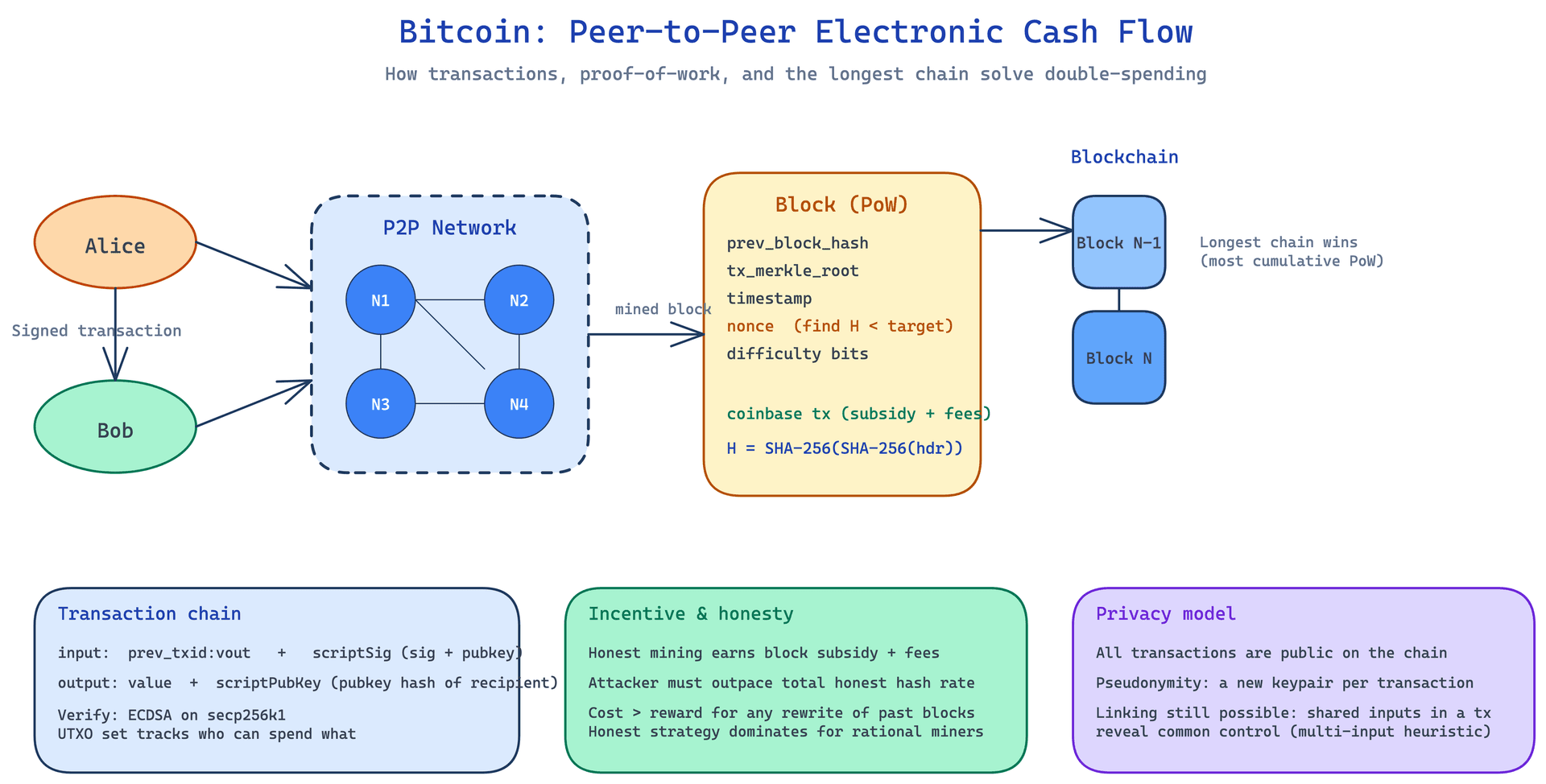
A few details from the diagram are worth lingering on because they are not obvious from a casual read of the paper. First, the block header is what miners actually commit to. It contains the previous block's hash, the Merkle root of the transactions, a timestamp, the difficulty bits, and the nonce. The double-SHA-256 of that header is the value that has to come in below the target; if any field changes, the hash changes completely, which is what makes the chain tamper-evident. Second, the coinbase transaction is special. It creates new bitcoin out of thin air, paying the subsidy to the miner's own address, plus any transaction fees collected from the transactions included in the block. The subsidy is what bootstraps the system before fees alone can pay for security. Third, transactions are not accounts; they are chains of unspent outputs. Alice's "balance" is the sum of UTXOs her private keys can sign for, and a payment consumes some of those UTXOs as inputs and creates new ones as outputs. The UTXO set is the part of the ledger that nodes keep in memory for fast validation, and it is the only state the system actually needs.
The privacy model in the diagram is more nuanced than the original paper suggests. The whitepaper recommends that users generate a fresh keypair for each transaction as a kind of pseudonymity, but the multi-input heuristic (the observation that several inputs in a single transaction almost always belong to the same wallet) was already a well-known de-anonymization vector by 2011. The paper does not solve privacy; it solves consensus, and the privacy gap seeded a decade of follow-on work in CoinJoin, ring signatures, and zero-knowledge proofs.
What the Paper Claims, and What It Actually Proved
The claims in the whitepaper fall into a few clear categories, and they have aged differently. The strongest claims are the protocol ones: that an attacker with less than 50% of the hash rate has a vanishing probability of catching up after z confirmations, and that the incentive structure (subsidy plus fees) makes honest mining the dominant strategy for a rational miner. The math for both is given explicitly in Section 11 and Section 12 of the paper, and it has held up under fifteen years of adversarial pressure. The 51% attack is a real, demonstrated threat. Ethereum Classic, Bitcoin Gold, and other chains have all suffered partial double-spends from it, and the whitepaper's framework for thinking about it is still the standard reference.
The medium-strength claims are the privacy and efficiency ones. The paper claims that the public-key system keeps transactions anonymous, which we now know to be overstated. It claims that disk and bandwidth requirements are manageable because Merkle trees let a node prune old transaction data, which is true in principle and has been implemented in various forms but is not the default. It claims that the network can run on a residential internet connection, which is roughly true for full nodes but is a more demanding proposition than the paper makes it sound, especially for the UTXO set.
The weakest claims, in hindsight, are the political ones. The paper suggests that the network will be self-policing because honest nodes are the majority. The reality, fifteen years later, is that mining is concentrated in industrial pools, that mining follows electricity prices into specific jurisdictions, that transaction fees are now the dominant long-term security budget question, and that the original 10-minute block target is widely considered too slow for retail payments. None of these contradict the paper, but none of them are quite what the paper imagined either.
Why the 2008 Document Is Still the Reference
The whitepaper's enduring contribution is not any single cryptographic trick. The double-SHA-256, the Merkle tree, the longest-chain rule, and the difficulty adjustment were all known in 2008. Adam Back's Hashcash, Wei Dai's b-money, and Nick Szabo's bit gold had all proposed variants of proof-of-work based digital cash. What the paper does is assemble these pieces into a complete, working specification with a concrete numerical model of security, and in doing so it defines the research agenda for the next decade and a half.
Every major protocol question in the cryptocurrency space can be traced back to a paragraph in the paper. The block-size debate is a fight about what the paper's "simplified payment verification" section permits. The fee market is a fight about what happens when the subsidy schedule runs out, which the paper sketches in Section 6 but does not solve. The energy-consumption debate is a fight about whether the proof-of-work security model is worth its externalities, a question the paper does not consider. The privacy-coins and ZK-rollups space is a fight about the privacy gaps the paper left open in Section 7. The argument is not that Satoshi predicted all of this. The argument is that he wrote the first version of a specification that has been extended, contested, and rewritten in production for fifteen years.
This is also why the question the r/Bitcoin thread asked is a useful one, and not just for retail traders. Reading the whitepaper in 2026 is a different exercise than reading it in 2008. The 2008 reader needed to understand proof-of-work. The 2026 reader needs to understand what the paper chose not to specify, and what that silence has cost the ecosystem.
What the Paper Got Wrong, and What It Quietly Left Out
A few honest caveats. The paper was not peer reviewed. It was posted to a cryptography mailing list and refined through public feedback. Several details changed between the original mailing-list post and the version that ended up in the bitcoin.org PDF, most visibly the signature opcodes, which were disabled after a buffer-overflow bug in 2010. The privacy model is the most often-cited weak point. The throughput ceiling (roughly 7 transactions per second given the 1 MB block target and 10-minute interval) is a real engineering limit, not a marketing one, and the paper's only nod to it is the "simplified payment verification" sketch in Section 8.
The whitepaper is also quiet on governance. It does not specify how the protocol should evolve, how to handle a bug, or what to do if hash rate drops. The de facto answer, rough consensus among core developers, mining signaling via version bits, and the threat of a user-activated soft fork, was not in the paper. It was discovered.
None of this is a knock on the paper. It is short, dated 2008, and it solved the problem it set out to solve. The questions it left open are the questions that have funded a generation of follow-on research, and a great deal of the volatility currently showing up on the price chart in 2026 is downstream of design choices the whitepaper made implicitly rather than explicitly.
If you have not read the original nine pages, the threads on r/Bitcoin are right: it is worth the half hour, and the context it gives you is not the context that price commentary provides. The chart is downstream of the protocol. The protocol is what the paper actually described.
Sources
- Satoshi Nakamoto, "Bitcoin: A Peer-to-Peer Electronic Cash System," October 31, 2008 (text mirror at bitcoinbook.hankmo.com/appa_whitepaper.html; PDF historically distributed at bitcoin.org/bitcoin.pdf)
- r/Bitcoin thread, "How long after buying Bitcoin did you actually read the whitepaper?", reddit.com/r/Bitcoin/comments/1tzmne7 (June 7, 2026)
- Bloomberg, "Bitcoin Has Longest Losing Streak Since August in Bruising Week," June 4, 2026 (via Hacker News, news.ycombinator.com)
- CNBC, "Bitcoin cracks $60k, sinking to lowest level since October 2024," June 5, 2026
- Reuters, "Bitcoin's star fades, as investors flock to lustre of AI and megacap IPOs," June 5, 2026
- SSRN preprint mirror, "Bitcoin: A Peer-to-Peer Electronic Cash System" (Solomonick), ssrn.com/abstract=3440802