The Nine-Page Paper That Quietly Replaced the Counterparty
On October 31, 2008, a person or small group working under the name Satoshi Nakamoto emailed a nine-page PDF to a small mailing list of cryptography enthusiasts. The document was called "Bitcoin: A Peer-to-Peer Electronic Cash System." It was not peer reviewed. It was not affiliated with a university. It was not published in a journal. Within a few years, it had become the foundation of an asset class now worth over a trillion dollars, the seed of a research program that has reshaped distributed systems and applied cryptography, and the design that every major cryptocurrency since has had to argue with.
The remarkable thing about the paper is not that it invented new primitives. Most of the building blocks were already in circulation. Adam Back's Hashcash had been on the table since 2002. Merkle trees for set membership had been around since 1979. Public-key cryptography and digital signatures were decades old. What Nakamoto did was assemble these parts into a single, working protocol that solved a problem nobody had been able to solve in production: how do you reach consensus on the order of transactions between strangers, with no trusted party in the middle?
The double-spending problem is the heart of it. A digital coin is just a string of bits, and bits can be copied. With physical cash, I cannot hand you a $20 bill and then hand the same bill to someone else. With digital money, in the absence of a trusted ledger, I can broadcast the same payment to two recipients at once. Every digital cash system before Bitcoin solved this by handing the job to a server. PayPal, Visa, and the banks all maintain authoritative ledgers. You trust them. They are the counterparty. Nakamoto's bet was that you could remove the counterparty entirely, replacing institutional trust with hashing work and game theory.
Briefing registry
- Title: Bitcoin: A Peer-to-Peer Electronic Cash System
- Author: Satoshi Nakamoto
- Mailed: October 31, 2008, to the metzdowd.com cryptography mailing list
- Re-published: Ledger journal, Vol. 1, 2016 (the journal's inaugural issue)
- Identifier: No DOI. The canonical text is the PDF distributed via bitcoin.org
- Length: Nine pages
- References cited: 8, drawing on Wei Dai's b-money (1998), Adam Back's Hashcash (2002), Merkle's public-key protocols (1980), and a cluster of timestamping papers from Haber, Stornetta, Bayer, and Massias
- Source: bitcoin.org/bitcoin.pdf; mirror at the Nakamoto Institute
Why every digital cash system still needed someone to lean on
Commerce on the internet, as Nakamoto opens the paper, runs through financial institutions. You can buy a coffee with a card, but the transaction bounces through your bank, the merchant's bank, a card network, and a settlement layer before the bytes representing your money move at all. It works. It also comes with friction: transaction fees, settlement delays, fraud risk, chargeback disputes, and the awkward fact that no payment is truly final until some central party says so. Dai's b-money and a handful of other 1990s proposals had attacked the same targets without breaking through.
The trouble is that digital signatures alone do not solve the underlying puzzle. A signature can prove that Alice authorized a particular payment, but it cannot prove that Alice did not authorize the same payment to someone else first. To know which transfer is the real one, you need to know the order in which payments happened, and to agree on that order across a network of strangers, somebody has to keep the canonical ledger.
The classical fix is to give that job to a trusted mint. The mint receives every transaction, decides which came first, and issues a new coin to the recipient. This is essentially how banks and card networks function. It works, but the entire system is now anchored to a single point of failure, with all the censorship, surveillance, and operator risk that comes with it.
Swapping the trusted third party for a public ledger
Nakamoto's move is to swap the trusted third party for a public ledger whose order is enforced by hashing work. Every participant in the network holds a copy of the ledger. New transactions are broadcast to everyone. Each node collects recent transactions into a candidate block, then races to find a value called a nonce that, when combined with the rest of the block header, produces a SHA-256 hash below a target threshold. The first node to find a valid hash broadcasts its block, and the others check it and add it to their copy of the chain.
This is the proof-of-work step, and it does three things at once. First, it makes block creation expensive, so a participant cannot easily spam the network with fraudulent blocks. Second, it gives the network an objective way to choose between competing chains: the chain with the most cumulative work wins. Third, by tying votes to hashing power, it sidesteps the Sybil problem that breaks naive one-IP-one-vote systems. You can spin up a million virtual nodes. You cannot rent a million CPUs for free.
A node's signature is its CPU power, not its identity. The paper is explicit about this. As long as honest nodes control more total hashing power than any cooperating group of attackers, honest blocks will be produced faster than fraudulent ones, and the honest chain will outpace the alternative. An attacker who wants to rewrite history has to redo the proof-of-work for every block they want to change, plus enough additional blocks to catch up with the rest of the network. The further behind they start, the more unlikely their success becomes.
How a transaction becomes part of history
The diagram below walks through the path a payment takes, from the moment Alice decides to send Bob a coin to the moment that coin is considered settled.
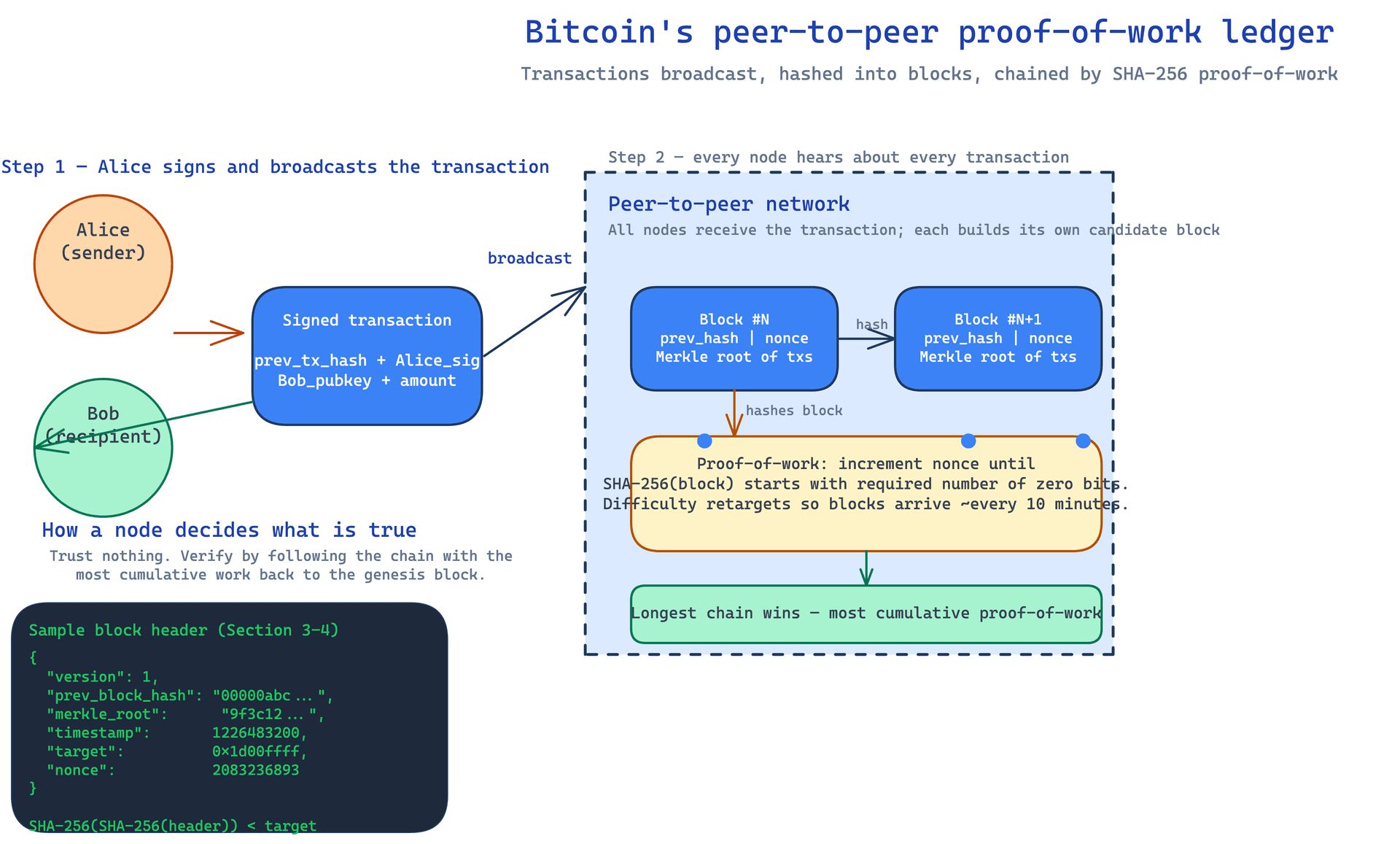
A node that wants to verify a payment has two options. It can run a full network node, which means downloading every block since the genesis block in January 2009 and checking them all. Or it can run simplified payment verification, which keeps only the block headers and asks other nodes for the Merkle branch connecting a specific transaction to a specific block's Merkle root. SPV is cheaper, but it relies on the assumption that honest nodes still dominate the network. Businesses that process frequent payments are expected to run full nodes. Casual users can get away with less.
The incentive structure is built into the protocol itself. The first transaction in each new block is special: it creates new coins out of thin air and assigns them to the miner who produced the block. This is the "block reward," and it is the mechanism that puts the currency into circulation in the first place. The paper also anticipates a second source of revenue, transaction fees, which take over once the block reward shrinks to zero. By design, miners are paid to do the only thing the system actually needs. The economic argument is that a miner with more hashing power than the rest of the network would be better off using that power to collect rewards than to attack the chain and devalue the coins they are paid in.
What the calculations actually prove
Section 11 is the part of the paper that ages best, because it is the part that most needed to be right. Nakamoto frames the race between an honest chain and an attacker's alternative chain as a Binomial Random Walk, then uses the Gambler's Ruin formulation to compute the probability that an attacker z blocks behind ever catches up. The result, included as a C function in the paper, is that the probability drops exponentially with z. If honest nodes hold even a modest majority of hashing power, an attacker's odds collapse quickly as the depth of the buried transaction grows.
The paper publishes concrete numbers. With the attacker controlling 10 percent of the network, the chance of a successful double-spend after six confirmations is well under one in a hundred thousand. After ten confirmations, it is closer to one in a million. At 30 percent attacker power, the curve is steeper, but the formula still bites hard: an attacker would have to fall many blocks behind before their odds become negligible. Finality in Bitcoin is probabilistic rather than absolute, and the probability can be tuned by choosing how many confirmations to wait for. Six is the standard for casual use. Higher-value transfers wait longer.
This is the part of the paper most often missed by critics who say Bitcoin's decentralization is just security theater. The calculations do not assume miners are nice. They assume miners are greedy, and they show that greedy miners are still incentivized to follow the rules.
Reclaiming disk space and the privacy ceiling
Two sections of the paper deal with practical constraints that would otherwise limit the system. Section 7 tackles storage by using a Merkle tree to summarize all transactions in a block into a single root hash, which is the only part the block header needs to carry. Old transactions can be pruned; only the chain of headers has to be kept. Nakamoto estimated the headers would grow by about 4.2 MB per year, a number that turned out to be slightly optimistic once the block size stayed at 1 MB, but the design is sound.
Section 10 confronts the privacy problem. Because every transaction is broadcast publicly, the traditional banking model's information asymmetry disappears. Anyone can see that some address sent some amount to another address. The paper's answer is to recommend a new key pair for every transaction, breaking the flow of information at the link layer rather than at the counterparty layer. The system does not give you anonymity. It gives you pseudonymity, and it gives you a tool to keep that pseudonymity intact if you use it carefully.
Limits, risks, and what the paper does not solve
A fair reading of the paper has to acknowledge what it does not claim. The system is not yet finished. The paper sketches a design and runs the network for the first four and a half years as a kind of extended beta. Several problems are flagged but not resolved: the block size cap is a placeholder, the difficulty retargeting algorithm is rough, and the fee market is described as a future mechanism rather than a working one. The maximum block size of 1 MB, set in 2010 by Nakamoto as a stopgap, is already a source of heated debate in the developer community about how the network should scale.
The trust assumptions are also worth naming. Honest nodes must control more hashing power than attackers. That is a liveness assumption about the world, not a proof. It can break if mining becomes centralized, if a state actor buys or seizes a majority of hashing power, or if a quantum computer capable of inverting SHA-256 becomes cheap enough to repurpose for the task. The paper says nothing about governance, nothing about jurisdiction, and nothing about what happens when a bug is found in a multi-billion-dollar live system that nobody owns. These are open questions the community is grappling with right now.
The throughput ceiling is the most obvious trade-off. Bitcoin processes roughly seven transactions per second globally. Visa, by contrast, processes thousands. The paper does not pretend to compete on volume. It aims to settle a smaller number of high-value transfers with strong finality guarantees, and to do so without needing anyone's permission. Whether that trade-off is the right one is a question the protocol's community has been arguing about since 2010.
What the paper actually leaves us with
Fifteen years after the paper landed, every major cryptocurrency and most permissioned blockchain platforms borrow from its design. Proof-of-work, longest-chain consensus, Merkle commitments, block rewards as a Sybil defense, and probabilistic finality are now part of the standard vocabulary of distributed systems. The same paper has been cited, dissected, refuted, and rebuilt by thousands of follow-on works. The core mechanism has held up under more adversarial pressure than any of the original ten readers probably imagined, including a global network of miners, multiple state-level adversaries, and a decade of attempts to break it.
The paper does not finish the conversation. It opens one. The hardest questions, around scalability, governance, energy use, and post-quantum security, are still being worked on. The protocol that grew out of it now secures hundreds of billions of dollars in value, but the design is still the same nine pages of argument that landed on a small mailing list in October 2008.
Sources
- Satoshi Nakamoto, Bitcoin: A Peer-to-Peer Electronic Cash System, October 31, 2008.
- Nakamoto Institute mirror with sectioned HTML and references.
- Adam Back, Hashcash: A Denial of Service Counter-Measure, 2002.
- Wei Dai, b-money, 1998.
- Ralph C. Merkle, Protocols for Public Key Cryptosystems, Proc. 1980 Symposium on Security and Privacy, IEEE.
- Stuart Haber and W. Scott Stornetta, How to Time-Stamp a Digital Document, Journal of Cryptology, 1991.
- William Feller, An Introduction to Probability Theory and Its Applications, 1957 (referenced for the Gambler's Ruin calculation).