A Pseudonymous Credit Score for the Blockchain
Imagine an ATM with no name fields, no customer service desk, and no chargeback line. The lobby sees every transaction that has ever crossed it, but it does not know whose hand is sliding the card. Every other customer is just an opaque string of characters called a blockchain address. Welcome to cryptocurrency.
For most of the last decade, this has been the situation crypto users live in. Bitcoin and Ethereum are pseudonymous on purpose. Your wallet address is public, your identity is not. That gap is the design, and the loophole. A scammer can spin up a fresh address, post a too-good-to-be-true deal on Discord, drain the funds, and disappear. The victim has no 800 number to call and no way to undo the transfer. The blockchain will dutifully record the theft forever.
On 12 December 2024, IP Australia published a new patent application that tries to plug the loophole without breaking the pseudonymity. AU2024266762A1, titled "Blockchain transaction safety" and owned by the holding entity Strong Force Tx Portfolio 2018 LLC, claims a server that watches the public ledger, watches the scam lists, and learns to label every wallet address with a single number: how likely is this address to be a crook? That number, fed back to a wallet, becomes the equivalent of a "do not send" sticker on the receiver. The full diagram of how the pieces fit together is below; the rest of this piece unpacks what is actually being claimed, what is clever about it, and where the limits sit.
The patent at a glance
- Publication number: AU2024266762A1
- Title: Blockchain transaction safety
- Assignee: Strong Force Tx Portfolio 2018 LLC
- Inventors: Malcolm Garland; David Charles Kuchar
- Filed in Australia: 21 November 2024
- Published: 12 December 2024
- Status: Pending
- Earliest priority: US Provisional 62/639,955, filed 7 March 2018
- Family origin: US 16/295,153 (filed 7 March 2019) and PCT/US2019/021087
- Related US grant: US 12,165,154 B2, issued 10 December 2024
- Source: Google Patents, Espacenet, USPTO Global Dossier
The Australian application is the latest published member of a 2018-vintage patent family. The same family has been filed in the United States, Europe, and China, and a related US continuation (US 12,165,154 B2, "Decentralized safeguard against fraud") extended the original scoring idea into a multi-node consensus network. AU2024266762A1 is the Australian re-filing after the first Australian application in the family was abandoned during prosecution.
The pseudonymity problem
Cryptocurrency networks are two things at once: completely transparent, and completely anonymous. Every transaction from every wallet since the genesis block sits in a public ledger anyone can download. The catch is that wallet addresses are pseudonymous strings like 0x3a4f...c91b. Nothing on the chain says "Alice" or "Bob." The only way to attach a real identity to an address is for some off-chain actor to publish the link. An exchange that ran KYC, a court order, a self-doxxing tweet: any of these can do it.
That gap between transparency and identity is the entire fraud surface. With a credit card, the card network can reverse a fraudulent charge, the issuing bank can reissue the card, and the merchant can blacklist the bad actor. With a wire transfer, the originating bank can place a hold and the receiving bank can freeze the destination account. With cryptocurrency, the moment the private key signs a transaction, the funds are gone. The blockchain is final.
Here is what the loophole looks like in practice. A scammer creates a Discord account, posts a too-good-to-be-true deal, and asks for payment to a fresh wallet. The victim sends 2 ETH. Within minutes the funds hop through two or three intermediate addresses and end up at a tumbler. The victim has no 800 number to call, no chargeback to file, and no idea who is behind any of those wallets. The blockchain will record the theft in its public ledger for the rest of history.
The patent opens its specification with this exact framing, in so many words: "cryptocurrency funds sent to a fraudulent party may not be readily recovered." It argues that this missing payer protection caps the mainstream utility of cryptocurrencies, since existing web fraud controls (KYC, ACH reversals, card chargebacks) do not extend to on-chain transfers. The proposed substitute is a service that rates the address rather than the person, and that any wallet, exchange, or payment gateway can consult before letting a transaction through.
Treating the public ledger as a graph
The conceptual move is to stop treating the blockchain as a list of payments and start treating it as a transaction graph. A graph, in the data-structure sense, is a set of points (called nodes) connected by arrows (called edges), the same shape used to model social networks, road maps, or molecules. Here is the mapping the patent uses:
- A node in the graph is a blockchain address.
- A directed edge from node to node is a transaction in which sent funds to .
- The weight on that edge is the amount transferred.
- The label on a node is, where known, "fraud" or "not fraud," sourced from blacklists, watchlists, scam-report databases, social-media crawls, and curated partner feeds.
Once the ledger is in that form, a rich set of questions becomes answerable. How central is this address in the network? How quickly does it pass funds through? Is it one hop from a confirmed scammer, or five? Has it been quiet for a long time and only just woken up? These questions can be answered with numbers, the kind a machine-learning model can consume.
The patent calls the resulting pipeline the Trust System. The server ingests the ledger, ingests the fraud labels, and emits a per-address score that any wallet or exchange can call over an API. The score can be returned in any of three formats a customer picks: an integer band like 1 to 7 (where 1 is "almost certainly fraud"), a percentage 0 to 100% likelihood of fraud, or a signed decimal in where more negative is worse. The specification even contains a worked example: a wallet asks about a counterparty, gets back , and is shown the line "the receiver has likely engaged in fraudulent activity" in plain English, alongside a one-click "Cancel Transaction" button.
Anatomy of the trust pipeline
The end-to-end loop looks like this in the patent's own figure, and the diagram below is the simplest rendering of that flow.
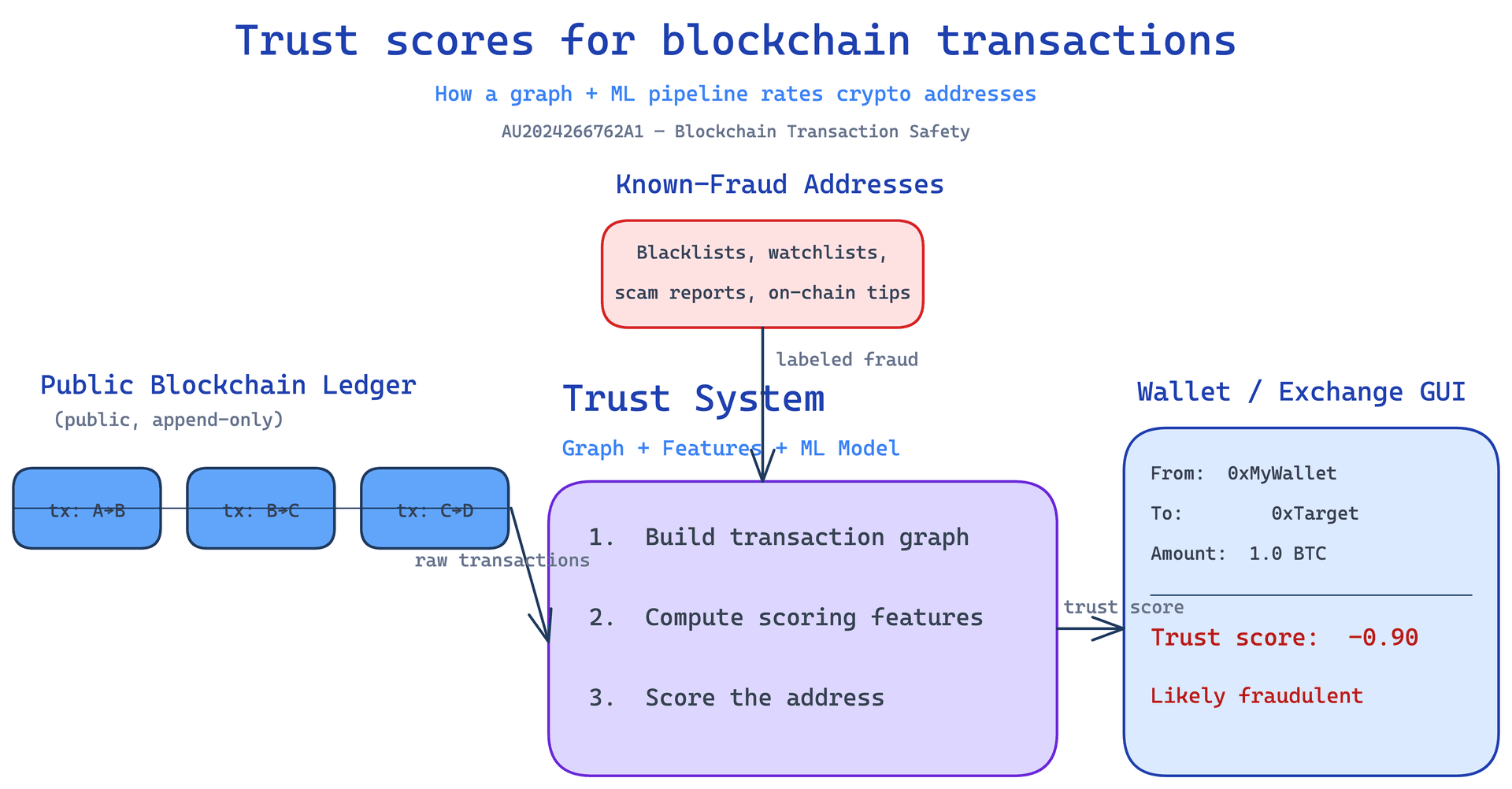
Read the picture left to right. On the far left is the Public Blockchain Ledger, a chain of blocks each containing a batch of transactions, written by miners or validators and replicated across thousands of nodes. Above the central pipeline, the Known-Fraud Addresses feed (blacklists, watchlists, scam reports, customer-supplied lists, peer-reviewed structured data) gives the system a supervised-learning target. In the middle is the Trust System itself: a server that builds a transaction graph, computes per-address features, and runs them through a trained classifier. On the right is a Wallet or Exchange GUI with a sample trust report: a counterparty at , a proposed send of 1.0 BTC, and the score flagged in red with the words "Likely fraudulent." The three labeled arrows (raw transactions, labeled fraud, and trust score) are the entire argument of the patent.
Behind that simple picture sits more machinery than the diagram shows. The rest of this section walks through it in four short pieces.
Per-address aggregates
The blockchain acquisition module reads raw ledger data from one or more networks (Bitcoin and Ethereum are called out by name, but the patent is written network-agnostically) and processes it into per-address aggregates.
These aggregates include total funds received, total funds sent, and average transaction size, plus timing-based measures such as the time between a fund's entry and its exit. They also include the dormancy probability, a number between 0 and 1 that captures how much longer the address has been silent than its own history would predict. A wallet that usually transacts daily but has been dark for six months gets a high score. A wallet that transacts once a year and is on schedule gets a low one.
The system also keeps a library of behavioral-template matches. A behavioral template is a checklist of conditions that defines one type of scam pattern. "Fewer than five transactions in a tight burst followed by immediate dormancy" is one such checklist. The system stores whether the address satisfies each template as a yes/no signal that flows into the model.
Importance and fraud distance
The graph processor then computes two more families of features on the resulting network.
Importance values capture how connected an address is. They include the in-degree (how many edges point in), the out-degree (how many edges point out), the in/out ratio by both count and amount, and classical graph-theoretic measures such as PageRank and Personalized Hitting Time. PageRank, originally the algorithm Google used to rank web pages, works by asking how likely a random walker (a hypothetical browser that clicks links at random) is to land on a given node. The patent applies the same idea to transactions: an address that many other addresses route funds through gets a high PageRank. Personalized Hitting Time generalizes the same logic: it asks how quickly a random walker starting from a fraud-labeled node would reach the address in question, so addresses that are topologically close to scammers get penalized even when their own volumes look innocent.
Fraud-distance values complete the picture. They include the minimum graph distance to any fraud-labeled node, the average distance, and the count of fraud-labeled neighbors within a small hop radius. The intuition is that an address sitting one hop from a confirmed scam wallet is more suspicious than one five hops away, even when transaction volumes look similar.
The feature vector and the classifier
The feature module assembles all of the above into a feature vector per address. A feature vector is a fixed-length list of numbers, equivalent to a single row in a spreadsheet, where each column is one of those computed measurements (dormancy, in-degree, PageRank, fraud-neighbor count, template-match flags, and so on).
A supervised learning classifier is then trained on the labeled subset, which contains addresses already known to be fraud plus a smaller pool of addresses known to be good (verified exchange wallets, audited smart contracts). The training procedure is the standard supervised-learning loop: feed the model thousands of (feature-vector, known-label) pairs, and let it adjust its internal parameters until it can predict the label from the features. Once trained, the model can be shown a brand-new address's feature vector and asked for a label it has never seen before.
The patent explicitly contemplates deep neural networks, random forests, decision trees, logistic regression, and "consensus of experts" ensembles, in which several different models vote like a jury and their votes combine into one final answer. Defending the model-architecture choice this broadly is a legal move: the assignee is reserving the right to swap in whatever classifier works best, and the patent will read on all of them.
What happens at query time
Once trained, the model is the only thing that needs to run at query time. A wallet sends a trust request with a target address, and the server returns a trust response with a score. Pre-computed scores are stored in an address record so that most queries are lookups, not fresh inference runs. The system falls back to real-time scoring only when the cache is missing or stale.
There is one more refinement: the query log itself becomes a feature. An address that many wallets are asking about is, all else equal, more suspicious than one nobody has ever queried. The system feeds on its own traffic.
What the claims actually cover
The Australian A1 publication contains 15 claims, the same shape as the rest of the family. The independent system claim 1 is a long but mechanical list of steps: a server pulls blockchain data, labels a subset of addresses as fraudulent, builds a graph, computes features (including at least one graph-based count feature), trains a model, generates a trust score per address, and serves that score through a graphical user interface. The 14 dependent claims layer in specifics, and they group into four families.
Graph-derived features (claims 2 through 5) cover the topological view: separate counts of inbound and outbound transactions, total funds flowing through the address, the distance in the graph between an address and a plurality of fraud-labeled nodes.
Temporal and volumetric features (claims 6 through 10) cover how the address behaves over time: its transaction rate, the total funds moved within a window, the time between a fund's arrival and its departure, raw dormancy, and dormancy relative to the address's expected cadence.
Behavioral and request-derived features (claims 11 through 14) cover the higher-order signals: a count of how many times the address has been looked up, boolean flags for matching against one or more behavior templates, and the ability to run multiple templates in parallel.
Labeling source (claim 15) keeps the system honest about where the truth comes from: the fraud labels are derived from an acquired list of fraudulent addresses, drawn from a blacklist, a watchlist, or a partner feed.
The breadth of claim 1 is the heart of the asset. It does not lock in any particular model, feature set, or score format. It locks in the system architecture (a closed loop of public data, fraud labels, a graph, a model, and an API) and trusts the assignee to fill in the algorithms later. This is defensive patent strategy: the broader the system claim, the harder it is for a competitor to build a trust-score product for blockchain addresses without tripping over it.
Why this framing matters beyond crypto
The most interesting thing about AU2024266762A1 is not the patent itself but the framing it imposes on the fraud problem. The mental model, a public, addressable record of money movement scored by a server that you can call, is increasingly general. Any networked ledger can in principle be cast as a graph of addresses and edges: the SWIFT message chain, the ACH network, the Federal Reserve's Fedwire, and the FedNow instant-payment rails. A trust system that scores senders and receivers for likelihood of fraud without ever needing to know their legal identities is a usable primitive for any of them.
Inside crypto, the commercial appeal is concrete. Today's exchanges, custodians, and payment gateways either build their own internal address-reputation lists (slow, narrow, easy to spoof) or buy them from specialist vendors such as Chainalysis, Elliptic, or TRM Labs. A granted patent on the architectural loop (pull ledger, pull labels, build graph, train model, serve score) does not stop the vendors from competing, but it does require them to license around the system claim if they want to use the patented combination.
There is also a consumer-protection story. In December 2024, the same week the related US patent issued, the US Office of the Comptroller of the Currency and other federal regulators were sharpening their guidance on bank-fintech partnerships and on fraud liability in the faster-payments era. A patent that gives wallets, exchanges, and underwriters a defensible way to inject a trust score into the user-facing send-or-don't-send decision is the kind of artifact those compliance teams can point to. It is not a regulatory product, but it is the kind of component those regulators expect to exist.
Where the limits sit
This is a published patent application, not a granted patent, and the specification is procedural rather than empirical. Six limits deserve to be called out.
First, the system is only as good as its labels. A fraud pipeline that learns from blacklists and watchlists will miss any address that has not yet been reported, and over-flag any address that has been falsely reported. The patent acknowledges that the fraud label is dispositive where present, but it does not solve the underlying label-quality problem.
Second, dormancy cuts both ways. A long-dormant legitimate address (a lost-wallet cold-storage address, a Satoshi-era dust collection) looks identical in its dormancy profile to a long-dormant scam wallet. The patent leans on behavioral-template features to break the tie, but it offers no experimental evidence of how often the templates misfire.
Third, the model is deliberately unspecified. The claims say "scoring model" without committing to a particular architecture. That is good legal hygiene and bad engineering clarity. Anyone reading the patent today cannot tell from the document alone which classifier is best, which features matter most, or what the false-positive rate is. The assignee may publish follow-on work; the patent as filed does not.
Fourth, no metrics. The specification contains no precision/recall numbers, no AUC curves, no false-positive budgets, no latency measurements. Any "X% accurate" claim is out of scope of the document itself. That is normal for a system patent, but it leaves a reader with no calibration for how good the system actually is in practice.
Fifth, pseudonymity, not anonymity. Trust scores leak information. If the same custodian looks up the same counterparty ten times in a week, both the custodian's behavior and the counterparty's identity get partly exposed through the query log. The patent treats this as a feature (the request data is itself a scoring input), but it is a privacy side effect that any real deployment would have to govern.
Sixth, jurisdictional uncertainty. AU2024266762A1 is the third Australian publication in the family. The first was abandoned during prosecution. The second is this one, still under examination. Until an Australian examiner weighs in, the breadth of claim 1 is an assertion, not a settled right. The same caveat applies to the EP and CN members of the family.
What to watch next
Three things make the rest of 2025 interesting for this patent family.
The Australian examination outcome on AU2024266762A1 is the first. If the examiner narrows the independent claim, the family becomes easier to design around. If it survives intact, the assignee has a defensible Australian patent covering the system architecture.
The public rollout, if any, of the related US 12,165,154 B2 multi-node consensus scoring network is the second. It would let independent servers each compute local trust scores and combine them into a single network-wide score without sharing raw customer data. That is a real architectural change from a single-server trust system, and it would push the patent's idea into a multi-operator setting.
The convergence of address-reputation vendors and bank fraud platforms is the third. If the patent's system claim is taken seriously, the natural licensees are the analytics shops (Chainalysis-style) and the payment gateways (Stripe-style) whose fraud teams already operate somewhere on the boundary between KYC and pseudonymity.
For now, the patent is best read as a map of the problem and a perimeter around the solution, not a finished product. The interesting claim is not any single feature. It is the loop. Public ledger, fraud list, graph, model, score, wallet, send-or-cancel. The rest of 2025 will be about who gets to own that loop, in which jurisdiction, and at what price.
Sources
- Google Patents: AU2024266762A1
- Espacenet: AU2024266762A1
- USPTO Global Dossier: AU/2024266762/1
- IP Australia patent search: ipsearch.ipaustralia.gov.au/patents
- Related US grant: US 12,165,154 B2, "Decentralized safeguard against fraud"
- WIPO PATENTSCOPE: PCT/US2019/021087
- US priority chain: US 16/295,153